


fme_1084202 - SECOND EMPIRE Médaille, Bureau de bienfaisance

50.00 €
Количество
Добавить в корзину

Тип Médaille, Bureau de bienfaisance
Дата: 1862
Монетный двор / Город: Paris
Металл: copper
Диаметр: 41,5 mm
Ориентация осей монеты: 12 h.
Гравер CAQUÉ Armand Auguste (1795-1881)
Вес: 34,64 g.
Век: lisse + abeille CUIVRE
Пуансон: Abeille (1860 - 1880) CUIVRE
Комментарии о состоянии
Jolie patine marron avec quelques points d’usure et traces de manipulation. Traces de nettoyage au revers. Petits coups sur les bords de la tranche
Ссылки в каталоге: :
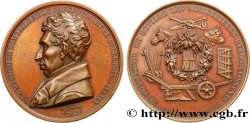
Лицевая сторона
Аверс: легенда: ANTOINE JEAN BAPTISTE - ROBERT AUGET DE MONTYON.
Аверс: описание: Buste de Montyon à droite ; signé Caqué cursif sur la tranche du cou et à l'exergue en deux lignes : CAQUE / GRAVEUR DE S. M. L'EMPEREUR.
Обратная сторона
Реверс: легенда: VILLE DE PARIS - (FLEUR) VINGTIÈME ARRONDISSEMENT (FLEUR) // AU CENTRE EN SIX LIGNES : LE BUREAU / DE BIENFAISANCE / A. MR / HOUDART / - / 1861-62.
Реверс: Описание: Légende circulaire et en 6 lignes dans une couronne de chêne.
Комментарий
Médaille décernée à Monsieur Houdart par le bureau de bienfaisance du 20e arrondissement de Paris.
Jean-Baptiste Antoine Auget Baron de Montyon (1733-1820) fut d'abord avocat au Châtelet en 1755, puis maître des requêtes au Conseil d'État (1760) et intendant d'Auvergne, de Provence. Il fut ensuite conseiller d'État en 1775 avant de devenir chancelier de Monsieur, frère du roi. Il avait amassé une fortune considérable. Il émigra en 1789 et ne revint en France qu'en 1814. En mourant, il laissa une fortune considérable et de nombreuses fondations.
Medal awarded to Mr. Houdart by the charity office of the 20th arrondissement of Paris. Jean-Baptiste Antoine Auget, Baron de Montyon (1733-1820), was first a lawyer at the Châtelet in 1755, then Master of Requests at the Council of State (1760) and Intendant of Auvergne and Provence. He was subsequently a Councillor of State in 1775 before becoming Chancellor to Monsieur, the king's brother. He had amassed a considerable fortune. He emigrated in 1789 and did not return to France until 1814. Upon his death, he left a considerable fortune and numerous foundations.
Jean-Baptiste Antoine Auget Baron de Montyon (1733-1820) fut d'abord avocat au Châtelet en 1755, puis maître des requêtes au Conseil d'État (1760) et intendant d'Auvergne, de Provence. Il fut ensuite conseiller d'État en 1775 avant de devenir chancelier de Monsieur, frère du roi. Il avait amassé une fortune considérable. Il émigra en 1789 et ne revint en France qu'en 1814. En mourant, il laissa une fortune considérable et de nombreuses fondations.
Medal awarded to Mr. Houdart by the charity office of the 20th arrondissement of Paris. Jean-Baptiste Antoine Auget, Baron de Montyon (1733-1820), was first a lawyer at the Châtelet in 1755, then Master of Requests at the Council of State (1760) and Intendant of Auvergne and Provence. He was subsequently a Councillor of State in 1775 before becoming Chancellor to Monsieur, the king's brother. He had amassed a considerable fortune. He emigrated in 1789 and did not return to France until 1814. Upon his death, he left a considerable fortune and numerous foundations.
Историческая справка
SECOND EMPIRE
(02/12/1852-04/09/1870)
Proclaimed Emperor under the name of Napoleon III, Louis Napoleon made his solemn entry into Paris on December 2, 1852.. He married Eugénie Marie de Montijo, a Spanish aristocrat, in January 1853. His reign can be divided into three periods: the authoritarian Empire until 1860; the Liberal Empire from 1860 to 1870 then the Parliamentary Empire in 1870. During the authoritarian Empire, Napoleon III exercised his power without sharing, controlled the press while the newspapers practiced self-censorship to avoid their suppression.. The prefects exercise unlimited power in the departments, the mayors, the civil servants are appointed by the government. As under the First Empire, Education and the University are monitored. Maintaining the main principles of the revolution, the sovereignty of the people is continued thanks to the consultation by plebiscite. On the economic level, the boom is important, industrialization develops as well as credit organizations and department stores. Military prestige is increased by the Crimean War which allows France to play an international role. The attack of Orsini (January 1858) does not prevent France from intervening in Italy to make triumph the principle of nationalities and allows the attachment of Nice and Savoy by the treaty of Turin (March 1860). From 1860, the Empire moved towards more freedoms: free trade treaty with England, appearance of a weak opposition in the Legislative Body, granting of the right to strike (1864), liberalization of the press (1868). On the international level, France acquires New Caledonia, Cochinchina and encourages the digging of the Suez Canal by Ferdinand de Lesseps. In Mexico, however, support for Maximilian and Austria was a failure. The 1869 elections were very bad for the regime and the opposition obtained 45% of the votes. The regime then evolved towards a parliamentary Empire by calling Émile Ollivier, leader of the Orléanist and liberal party, to power. After Sadowa in 1866 when Prussia crushed Austria, the affair of the throne of Spain and the dispatch from Ems led to the war which was declared on July 19, 1870. Accumulating setbacks, the French army was surrounded in Metz then Napoleon III, ill, capitulated at Sedan on September 2. As soon as the news was known, the decline of the Empire was announced by Gambetta, then the Republic was proclaimed on September 4.. Napoleon III was then taken captive to Hesse and then left for Kent where he died in 1873..
 Cообщить об ошибке
 Распечатать страницу
 Отправить мой выбор
 Задать вопрос
 Consign / sell
ПОХОЖИЕ ТОВАРЫ
 Информация



Your Recently Viewed Items
50 Ringgit - 50 Dollars BRUNEI 1973 P.09a VF-
100.00 €
50 Ringgit - 50 Dollars Commémoratif BRUNEI 2004 P.28 AU
34.00 €
THRACE - ODESSOS Tétradrachme MS
840.00 €
GORDIAN III Sesterce VF
35.00 €

CONSTANTIUS II Centenionalis ou nummus AU/AU
60.00 €

MONACO 1 Cent ARMOIRIES 2001 MS
29.00 €
cgbfr.com для нумизматов


