


v59_0033 - SIRIA - REGNO DI SIRIA - ANTIOCO VIII GRYPOS Tétradrachme
MONNAIES 59 (2013)
Начальная цена : 650.00 €
Назначить цену : 950.00 €
Цена реализации : 767.00 €
Количество ставок : 2
Максимальная предлагаемая цена : 860.00 €
Начальная цена : 650.00 €
Назначить цену : 950.00 €
Цена реализации : 767.00 €
Количество ставок : 2
Максимальная предлагаемая цена : 860.00 €
Тип Tétradrachme
Дата: c. 115-113 AC.
Монетный двор / Город: Aké-Ptolémais,Phénicie
Металл: silver
Диаметр: 31,5 mm
Ориентация осей монеты: 12 h.
Вес: 16,06 g.
Редкость: R2
Комментарии о состоянии
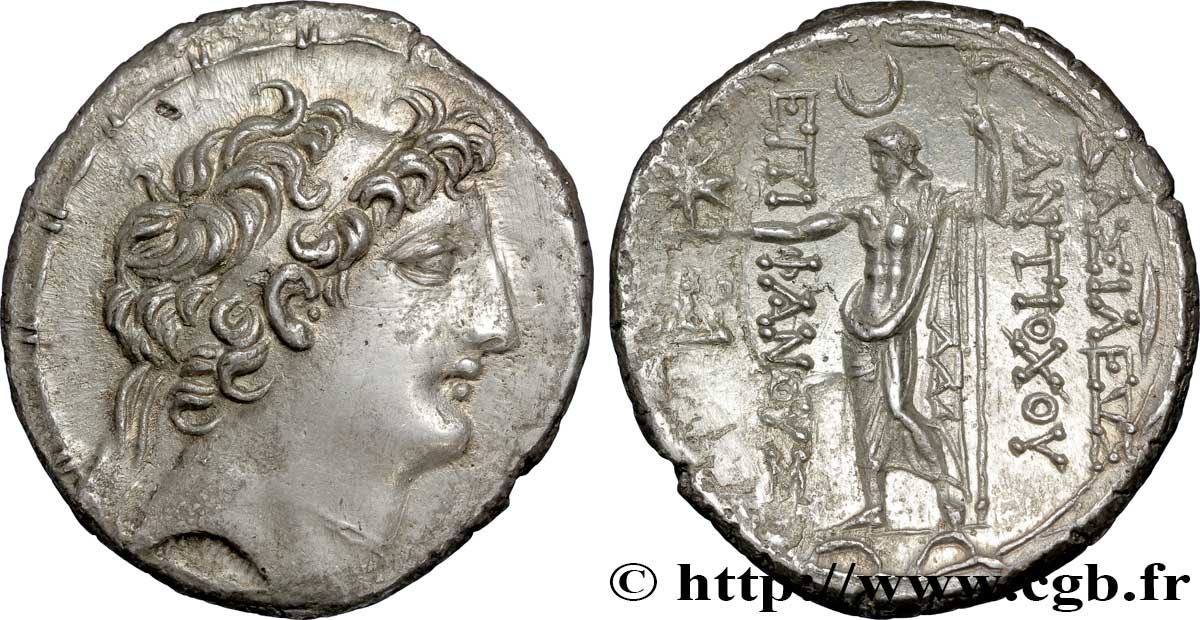
Exemplaire de qualité exceptionnelle sur un flan très large et ovale, parfaitement centré des deux côtés. Magnifique portrait d’Antiochus VIII de haut relief avec la stemma bien visible. Joli revers, bien venu à la frappe, finement détaillé. Très jolie patine de médaillier avec des reflets mordorés. Conserve l’intégralité de son brillant de frappe et de son coupant d’origine
Ссылки в каталоге: :
Происхождение:
Cet exemplaire provient de la vente Italo Vecchi XIV, n° 681
Лицевая сторона
Аверс: легенда: ANÉPIGRAPHE.
Аверс: описание: Tête diadémée d’Antiochus VIII à droite, entourée de la stemma.
Обратная сторона
Реверс: Описание: Zeus Uranios nu jusqu’à la ceinture, debout à gauche, la tête surmontée d'un croissant, à demi-nu, la chlamyde sur l'épaule, tenant une étoile à huit rais de la main droite et de la gauche un sceptre long (emblème luni-solaire).
Реверс: легенда: BASILEWS// ANTIOCOU// EPI-FANOUS// DAR
Реверс: перевод: (du roi Antiochus glorieux).
Комментарий
Sur cet exemplaire, Antiochus n’a pas l’appendice nasal proéminent qui le caractérise (grypus). La stemma est bien visible sur notre exemplaire. Il y avait trois exemplaires de ce type dans le trésor de Kessab (IGCH. 1568), enfoui vers 110 avant J.-C. et qui contenait plus de 388 monnaies d’argent dont 102 tétradrachmes d’Antiochus VIII avec 70 pièces pour l’atelier d’Aké-Ptolémaïs.
In this example, Antiochus does not have the prominent nasal appendage that characterizes him (grypus). The stemma is clearly visible on our example. There were three examples of this type in the Kessab treasure (IGCH. 1568), buried around 110 BC and which contained more than 388 silver coins including 102 tetradrachms of Antiochus VIII with 70 coins for the Aké-Ptolemais mint
In this example, Antiochus does not have the prominent nasal appendage that characterizes him (grypus). The stemma is clearly visible on our example. There were three examples of this type in the Kessab treasure (IGCH. 1568), buried around 110 BC and which contained more than 388 silver coins including 102 tetradrachms of Antiochus VIII with 70 coins for the Aké-Ptolemais mint
Историческая справка
SYRIA - SELEUKID KINGDOM - ANTIOCHUS VIII GRYPUS
(121-96 BC)
First reign
Antiochus VIII with the long nose (grypos) is the eldest son of Demetrius II and Cleopatra Thea. After a regency between 125 and 121 BC with his mother, whom he ended up poisoning before being assassinated himself, he had to fight for twenty years against his half-brother Antiochus IX Cyzicene (of Cyzicus) . Antioch had to be retaken four times. Antiochus reigned there from 121 to 113, then in 112 and 111, from 111 to 109, finally from 108 to 96 BC. Antiochus VIII was assassinated by his son Seleucus VI who also killed his uncle Antiochus IX before being himself eliminated by Antiochus X, son of Antiochus IX in 96 BC, a beautiful family story.
 Cообщить об ошибке
 Распечатать страницу
 Отправить мой выбор
 Задать вопрос
 Consign / sell
ПОХОЖИЕ ТОВАРЫ

 Информация


Your Recently Viewed Items
GALLIA - AULERCI CENOMANI (Area of Le Mans) Statère d'or au cheval anthropomorp
6000.00 €
LOUIS XIV "THE SUN KING" Écu aux trois couronnes 1709 Paris AU
700.00 €

GALLIA - BELGICA - BELLOVACI (Regione di Beauvais) Bronze au personnage agenouil
180.00 €
ITALIA - LIGURIA - REPUBBLICA DE GENOVA Gênois (Genovino) n.d. Gênes XF
1100.00 €
BITURIGES CUBI, INCERTI Bronze au loup et au pégase à gauche, à la croix boul
340.00 €

CONTADO VENASSINO - AVIGNONE - CLÉMENT VI (Pierre Roger de Beaufort) Gros tourn
2450.00 €
cgbfr.com для нумизматов


