


bga_1136397 - GALLIA BELGICA - MORINI (littoral Area of the English Channel and the North Sea) Quart de statère au bateau, uniface

600.00 €
Количество
Добавить в корзину

Тип Quart de statère au bateau, uniface
Дата: c. 70-50 AC.
Металл: gold
Диаметр: 10,5 mm
Вес: 1,37 g.
Редкость: R2
Комментарии о состоянии
Beau quart bien centré. Patine de collection
Происхождение:
Collection Paul Bancroft, UK
Лицевая сторона
Аверс: легенда: ANÉPIGRAPHE.
Аверс: описание: Lisse.
Обратная сторона
Реверс: легенда: ANÉPIGRAPHE.
Реверс: Описание: “Arbre” flanqué de deux symboles ornementaux horizontaux ; au-dessous, ligne brisée en forme de faucille avec deux symboles en forme de croissant et de gamma minuscule.
Комментарий
Ce type de monnaie communément décrit “au bateau” est décrit à “l’arbre et à la ligne brisée” dans le Nouvel Atlas. Certains préfèrent y voir un personnage avec un casque surdéveloppé...
Cet exemplaire avec un revers neuf et un avers presque lisse aurait été frappé avec un coin de droit usé associé à un nouveau coin de revers. Cette association est assez courant et ne semble pas avoir choqué les gaulois ! (cf. DT. 250 - 254).
This type of coin commonly described as \\\"with a boat\\\" is described as \\\"with a tree and a broken line\\\" in the New Atlas. Some prefer to see it as a figure with an overdeveloped helmet... This example with a new reverse and an almost smooth obverse would have been struck with a worn obverse die associated with a new reverse die. This association is quite common and does not seem to have shocked the Gauls! (cf. DT. 250 - 254)
Cet exemplaire avec un revers neuf et un avers presque lisse aurait été frappé avec un coin de droit usé associé à un nouveau coin de revers. Cette association est assez courant et ne semble pas avoir choqué les gaulois ! (cf. DT. 250 - 254).
This type of coin commonly described as \\\"with a boat\\\" is described as \\\"with a tree and a broken line\\\" in the New Atlas. Some prefer to see it as a figure with an overdeveloped helmet... This example with a new reverse and an almost smooth obverse would have been struck with a worn obverse die associated with a new reverse die. This association is quite common and does not seem to have shocked the Gauls! (cf. DT. 250 - 254)
Историческая справка
GALLIA BELGICA - MORINI (coastal area of the English Channel and the North Sea)
(2nd - 1st century BC)
The Morins, people of Belgian Gaul, were located by the sea between Étaples and Bruges in the current departments of Pas-de-Calais and Nord for France and regions of maritime Flanders and Zeeland. Their neighbors were the Ambians, the Atrebates and the Menapians. They participated in the coalition of the Belgian peoples in 57 BC, led by the Bellovaques. They provided a contingent of twenty five thousand men. In 56 BC, they joined the maritime coalition of the Veneti. Caesar led an expedition against the Morins and Menapians which ended in failure. However, it was from Portus Itius (Boulogne-sur-Mer), located on their territory, that Caesar embarked to invade the island of Brittany. After 54 BC, Caesar imposed the Atrebate Commios as king on the Morins in order to thank him for his help and support during the two expeditions to Brittany. In 52 BC, the Morins provided a contingent of five thousand men to the relief army. One of their oppida seems to have been Taruenna (Thérouanne). Caesar (BG. II, 4; III, 9, 28; IV, 21, 22, 37, 38; V, 24; VII, 75, 76).
 Cообщить об ошибке
 Распечатать страницу
 Отправить мой выбор
 Задать вопрос
 Consign / sell
ПОХОЖИЕ ТОВАРЫ

 Информация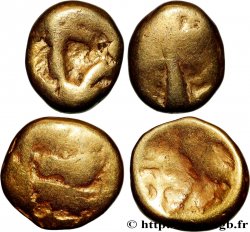
Your Recently Viewed Items

GALLIA BELGICA - MORINI (littoral Area of the English Channel and the North Sea)
600.00 €
cgbfr.com для нумизматов


