


bpv_141549 - AUGUSTUS Tétradrachme syro-phénicien
недоступный.
Товар уже продан в нашем интернет-магазине
Цена: : 280.00 €
Товар уже продан в нашем интернет-магазине
Цена: : 280.00 €
Тип Tétradrachme syro-phénicien
Дата: 31-30 AC.
Монетный двор / Город: Antioche, Syrie, Séleucie et Piérie
Металл: silver
Диаметр: 26 mm
Ориентация осей монеты: 12 h.
Вес: 14,26 g.
Редкость: R1
Комментарии о состоянии
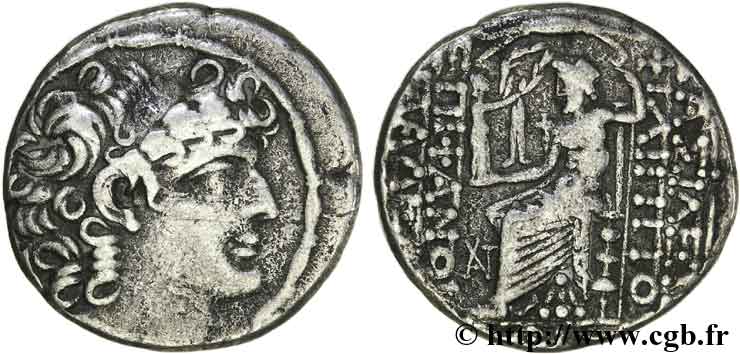
Décentrée au droit, bon centrage au revers avec la date bien lisible
Ссылки в каталоге: :
Лицевая сторона
Аверс: легенда: ANÉPIGRAPHE.
Аверс: описание: Tête diadémée de Philippe Philadelphe à droite, entouré de la stemma (O’).
Обратная сторона
Реверс: Описание: Zeus assis à gauche sur un trône avec dossier, tenant de la main droite une Niké qui le couronne et un sceptre long de la main gauche ; au-dessus de Zeus, le foudre ; monogramme dans le champ à gauche ; date à l’exergue.
Реверс: легенда: BASILEWS/ FILIPPOU/ EPIFANOUS/ FILADELFOU, QI(Basilews Filippou Epifanous Filadelfou)
Реверс: перевод: (Roi Philippe Epiphane Philadelphe/ monogramme d’Antioche et millésime 19).
Комментарий
An 19 de l’ère césarienne, première année frappée sous Auguste de la série intermédiaire entre les frappes séleucides et les frappes impériales syriennes, peut-être à l’occasion de sa visite dans la ville, après Actium. La colonisation romaine se conforte et la Syrie devient une province impériale gérée par un Legatus Augusti. La monnaie, bien que contrôlée par Rome, reste toujours au type séleucide et seul le petit monogramme marque la différence.
Les émissions au type immobilisé de Philippe Philadelphe sont très importantes car elles illustrent parfaitement la logique impériale de la colonisation romaine. Autant une conquête de revendication territoriale d'expansion de l'espace vital autour d'un pouvoir central de type national va chercher à éliminer toutes les symboliques locales dans les pays conquis pour imposer celles du conquérant (selon le principe de un peuple, un roi, une foi, une loi), autant un empire va laisser cohabiter des symboliques différentes. C'est ce qui se passe en Syrie, Palestine et Phénicie dans les premiers temps de l'expansion. Loin d'imposer le denier ou la typologie romaine, les Latins vont respecter la métrologie et même le type. Il faudra attendre les rares émissions d'Auguste au revers du Zeus, presque cinquante ans, pour voir apparaître le portrait du Prince sur les monnaies locales en argent.
Style classique pour l’émission avec les mèches traitées en “serpents”. On remarquera le style du plissé de l’himation de Zeus que nous retrouverons exactement dans la première émission au portrait d’Auguste.
Dans la base TSP maintenue par Michel Prieur, dix-neuf exemplaires sont maintenant répertoriés mais il faut noter que sur ce total, treize sont en musées ou collections publiques. Cet exemplaire est le 0013_001.
Year 19 of the Caesarean era, first year struck under Augustus in the intermediate series between the Seleucid strikes and the Syrian imperial strikes, perhaps on the occasion of his visit to the city, after Actium. Roman colonization was consolidated and Syria became an imperial province managed by a Legatus Augusti. The coin, although controlled by Rome, still remains of the Seleucid type and only the small monogram marks the difference.
The immobilized type emissions of Philippe Philadelphe are very important because they perfectly illustrate the imperial logic of Roman colonization.. Just as a conquest of territorial claim of expansion of the living space around a central power of national type will seek to eliminate all local symbols in the conquered countries to impose those of the conqueror (according to the principle of one people, one king, one faith, one law), so an empire will allow different symbols to coexist. This is what happened in Syria, Palestine and Phoenicia in the early days of expansion.. Far from imposing the denarius or Roman typology, the Latins will respect metrology and even the type. It was not until the rare issues of Augustus on the reverse of the Zeus, almost fifty years later, that the portrait of the Prince appeared on local silver coins..
Classic style for the show with the strands treated in “snakes”. We will notice the style of the pleating of the himation of Zeus that we will find exactly in the first emission with the portrait of Augustus.
In the TSP database maintained by Michel Prieur, nineteen examples are now listed but it should be noted that of this total, thirteen are in museums or public collections.. This example is 0013_001
Les émissions au type immobilisé de Philippe Philadelphe sont très importantes car elles illustrent parfaitement la logique impériale de la colonisation romaine. Autant une conquête de revendication territoriale d'expansion de l'espace vital autour d'un pouvoir central de type national va chercher à éliminer toutes les symboliques locales dans les pays conquis pour imposer celles du conquérant (selon le principe de un peuple, un roi, une foi, une loi), autant un empire va laisser cohabiter des symboliques différentes. C'est ce qui se passe en Syrie, Palestine et Phénicie dans les premiers temps de l'expansion. Loin d'imposer le denier ou la typologie romaine, les Latins vont respecter la métrologie et même le type. Il faudra attendre les rares émissions d'Auguste au revers du Zeus, presque cinquante ans, pour voir apparaître le portrait du Prince sur les monnaies locales en argent.
Style classique pour l’émission avec les mèches traitées en “serpents”. On remarquera le style du plissé de l’himation de Zeus que nous retrouverons exactement dans la première émission au portrait d’Auguste.
Dans la base TSP maintenue par Michel Prieur, dix-neuf exemplaires sont maintenant répertoriés mais il faut noter que sur ce total, treize sont en musées ou collections publiques. Cet exemplaire est le 0013_001.
Year 19 of the Caesarean era, first year struck under Augustus in the intermediate series between the Seleucid strikes and the Syrian imperial strikes, perhaps on the occasion of his visit to the city, after Actium. Roman colonization was consolidated and Syria became an imperial province managed by a Legatus Augusti. The coin, although controlled by Rome, still remains of the Seleucid type and only the small monogram marks the difference.
The immobilized type emissions of Philippe Philadelphe are very important because they perfectly illustrate the imperial logic of Roman colonization.. Just as a conquest of territorial claim of expansion of the living space around a central power of national type will seek to eliminate all local symbols in the conquered countries to impose those of the conqueror (according to the principle of one people, one king, one faith, one law), so an empire will allow different symbols to coexist. This is what happened in Syria, Palestine and Phoenicia in the early days of expansion.. Far from imposing the denarius or Roman typology, the Latins will respect metrology and even the type. It was not until the rare issues of Augustus on the reverse of the Zeus, almost fifty years later, that the portrait of the Prince appeared on local silver coins..
Classic style for the show with the strands treated in “snakes”. We will notice the style of the pleating of the himation of Zeus that we will find exactly in the first emission with the portrait of Augustus.
In the TSP database maintained by Michel Prieur, nineteen examples are now listed but it should be noted that of this total, thirteen are in museums or public collections.. This example is 0013_001
Историческая справка
AUGUSTUS
(01/16/27 BC - 08/19/14 AD)
Augustus, after Actium and the taking of Alexandria, remains the sole master of the Roman Empire. He gave his powers to the senate in 27 and was honored with the title of august, giving birth to a new political regime: the principate.. The next forty years will be devoted to structuring and consolidating the system put in place by Augustus on the political, economic and cultural level.. He is assisted by Agrippa, who becomes his son-in-law by marrying his daughter Julia in 21 BC.. -VS. and bears him two grandsons, Caius and Lucius. Unfortunately, Agrippa, friend and double, died in 12 BC.. -VS. On the military level, he is seconded first by Drusus then by Tiberius - the two sons of his third wife, Livia. On the cultural level, the arbiter of fashions is Patron. With his epic the Aeneid, new Iliad and Odyssey, Virgil recalls the mythical birth of Rome and exalts the Roman virtues.. With skillful diplomatic and military activity, and despite the disaster of Varus in 9 AD, Augustus fixed the limes on the Rhine-Danubian front, benefiting from the repeated campaigns of Drusus, then Tiberius, and the end of the reign of Germanicus, son of Drusus. The relative peace with the Parthians is materialized by the return of the ensigns and prisoners of Carrhae (53 BC. -VS. ) in 20 BC. -VS. This event has a considerable impact. Augustus also reorganizes the senatorial and imperial provinces. He reserves the administration of Egypt. The last twenty years of his reign are dedicated to the preparation of his succession. One after the other, Agrippa died in 12 BC.. -VS. , Drusus in 9 BC. -VS. , then his two grandsons, Lucius in 2 and Caius in 4. Aged 77, Auguste died in Nola on August 19, 14, leaving the throne to Tiberius, new husband of Julie, already twice widowed.. His hopes also rest on Germanicus while Agrippa Posthumus has been sidelined. After his death, Augustus is deified and the Romans give his name to the eighth month of the year, August (augustus).
 Cообщить об ошибке
 Распечатать страницу
 Отправить мой выбор
 Задать вопрос
 Consign / sell
 Информация

cgbfr.com для нумизматов


