


Назад 1/1
bpv_295837 - AUGUSTUS Tétradrachme syro-phénicien

недоступный.
Товар уже продан в нашем интернет-магазине (2014)
Цена: : 750.00 €
Товар уже продан в нашем интернет-магазине (2014)
Цена: : 750.00 €
Тип Tétradrachme syro-phénicien
Дата: An 31 et 13e consulat
Монетный двор / Город: Antioche, Syrie, Séleucie et Piérie
Металл: silver
Диаметр: 26 mm
Ориентация осей монеты: 12 h.
Вес: 14,53 g.
Редкость: R1
Ссылки в каталоге: :
Происхождение:
Cet exemplaire est le 0056_015; il provient de la collection Richard McAlee et des plateaux de la maison Leu. C’est cet exemplaire qui illustre le type dans l’ouvrage de Richard McAlee The coins of Roman Antioch, page 115, n°186
Лицевая сторона
Аверс: описание: Tête laurée d’Auguste à droite entouré de la stemma (O*).
Аверс: легенда: KAISAROS SE-BASTOU (Kaisaros Sebastou)
Аверс: перевод: (César Auguste).
Обратная сторона
Реверс: Описание: Tyché (Ville d’Antioche) tourelée, voilée et drapée assise à droite sur un rocher, tenant une palme de la main droite ; à ses pieds à droite, l’Oronte nageant à droite.
Реверс: легенда: ETOUS - AL - NIKHS/ (UPAT) IG (Etous Nikhs)
Реверс: перевод: Nouvelle année victorieuse 31 / Treizième consulat / monogramme d’Antioche.
Комментарий
Cette émission, qui s’étend de l’an 27 (5 AC) à la mort de l’Empereur, en l’an 44 du règne (14 AD) présente un type religieux plus oecuménique que ceux qu’utilisèrent les Séleucides : la Tyché de la ville d’Antioche. On peut penser que l’Antioche de l’époque, probablement une ville de 150 à 200.000 habitants, était un creuset de cultes différents et que les Romains, plutôt que d’imposer un dieu particulier, choisirent une image dans laquelle tous les Antiochéens, voire tous les habitants de la région, pouvaient se reconnaître. La statue de la Tyché représentée au revers, était la statue cultuelle de l’artiste Eutychides, si célèbre que des copies d’époque nous en sont parvenues.
Cette pièce est datée de l’année théorique de naissance du Christ et nous permet de remarquer que l’an “0” n’existe pas. C’est aussi en cette année qu’Auguste envoya Gaius César en visite en Syrie afin d’assurer les meilleures relations possibles avec les rois-clients.
Dans la base TSP maintenue par Michel Prieur, vingt-huit exemplaires sont maintenant répertoriés dont six en musées ou collections publiques (Paris, British Museum, Copenhague, Berlin, Munich et Oxford).
This issue, which extends from the year 27 (5 BC) to the death of the Emperor, in the year 44 of the reign (14 AD) presents a more ecumenical religious type than those used by the Seleucids: the Tyche of the city of Antioch. It is possible to think that Antioch at that time, probably a city of 150 to 200. 000 inhabitants, was a melting pot of different cults and that the Romans, rather than imposing a particular god, chose an image in which all the Antiochians, indeed all the inhabitants of the region, could recognize themselves. The statue of Tyche depicted on the reverse was the cult statue of the artist Eutychides, so famous that examples of it from the period have come down to us..
This coin is dated to the theoretical year of Christ's birth and allows us to notice that the year “0” does not exist.. It was also in this year that Augustus sent Gaius Caesar on a visit to Syria to ensure the best possible relations with the client kings..
In the TSP database maintained by Michel Prieur, twenty-eight examples are now listed, including six in museums or public collections (Paris, British Museum, Copenhagen, Berlin, Munich and Oxford)
Cette pièce est datée de l’année théorique de naissance du Christ et nous permet de remarquer que l’an “0” n’existe pas. C’est aussi en cette année qu’Auguste envoya Gaius César en visite en Syrie afin d’assurer les meilleures relations possibles avec les rois-clients.
Dans la base TSP maintenue par Michel Prieur, vingt-huit exemplaires sont maintenant répertoriés dont six en musées ou collections publiques (Paris, British Museum, Copenhague, Berlin, Munich et Oxford).
This issue, which extends from the year 27 (5 BC) to the death of the Emperor, in the year 44 of the reign (14 AD) presents a more ecumenical religious type than those used by the Seleucids: the Tyche of the city of Antioch. It is possible to think that Antioch at that time, probably a city of 150 to 200. 000 inhabitants, was a melting pot of different cults and that the Romans, rather than imposing a particular god, chose an image in which all the Antiochians, indeed all the inhabitants of the region, could recognize themselves. The statue of Tyche depicted on the reverse was the cult statue of the artist Eutychides, so famous that examples of it from the period have come down to us..
This coin is dated to the theoretical year of Christ's birth and allows us to notice that the year “0” does not exist.. It was also in this year that Augustus sent Gaius Caesar on a visit to Syria to ensure the best possible relations with the client kings..
In the TSP database maintained by Michel Prieur, twenty-eight examples are now listed, including six in museums or public collections (Paris, British Museum, Copenhagen, Berlin, Munich and Oxford)
Историческая справка
AUGUSTUS
(01/16/27 BC - 08/19/14 AD)
Augustus, after Actium and the taking of Alexandria, remains the sole master of the Roman Empire. He gave his powers to the senate in 27 and was honored with the title of august, giving birth to a new political regime: the principate.. The next forty years will be devoted to structuring and consolidating the system put in place by Augustus on the political, economic and cultural level.. He is assisted by Agrippa, who becomes his son-in-law by marrying his daughter Julia in 21 BC.. -VS. and bears him two grandsons, Caius and Lucius. Unfortunately, Agrippa, friend and double, died in 12 BC.. -VS. On the military level, he is seconded first by Drusus then by Tiberius - the two sons of his third wife, Livia. On the cultural level, the arbiter of fashions is Patron. With his epic the Aeneid, new Iliad and Odyssey, Virgil recalls the mythical birth of Rome and exalts the Roman virtues.. With skillful diplomatic and military activity, and despite the disaster of Varus in 9 AD, Augustus fixed the limes on the Rhine-Danubian front, benefiting from the repeated campaigns of Drusus, then Tiberius, and the end of the reign of Germanicus, son of Drusus. The relative peace with the Parthians is materialized by the return of the ensigns and prisoners of Carrhae (53 BC. -VS. ) in 20 BC. -VS. This event has a considerable impact. Augustus also reorganizes the senatorial and imperial provinces. He reserves the administration of Egypt. The last twenty years of his reign are dedicated to the preparation of his succession. One after the other, Agrippa died in 12 BC.. -VS. , Drusus in 9 BC. -VS. , then his two grandsons, Lucius in 2 and Caius in 4. Aged 77, Auguste died in Nola on August 19, 14, leaving the throne to Tiberius, new husband of Julie, already twice widowed.. His hopes also rest on Germanicus while Agrippa Posthumus has been sidelined. After his death, Augustus is deified and the Romans give his name to the eighth month of the year, August (augustus).
 Cообщить об ошибке
 Распечатать страницу
 Отправить мой выбор
 Задать вопрос
 Consign / sell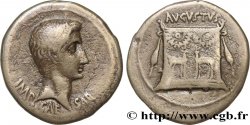
 Информация


Your Recently Viewed Items

5 Francs ALGERIA 1941 P.077a VF+
27.00 €

10 Pesos MEXICO 1996 P.105b F+
4.00 €

5 Pounds ST HELENA 1981 P.07b UNC
50.00 €

NICEPHORUS III BOTANIATES Follis XF
44.00 €
TOWN OF BESANCON - COINAGE STRUCK AT THE NAME OF CHARLES V Carolus VF
17.00 €

TRÉSOR ROYAL LOUIS XIV AU
76.00 €
cgbfr.com для нумизматов


