


bga_916679 - DANUBIAN CELTS - TETRADRACHMS IMITATIONS OF PHILIP II AND HIS SUCCESSORS Tétradrachme “au rameau”
недоступный.
Товар уже продан в нашем интернет-магазине (2024)
Цена: : 850.00 €
Товар уже продан в нашем интернет-магазине (2024)
Цена: : 850.00 €
Тип Tétradrachme “au rameau”
Дата: (IIe-Ier siècles avant J.-C.)
Металл: silver
Диаметр: 23,5 mm
Ориентация осей монеты: 3 h.
Вес: 14,19 g.
Редкость: R2
Комментарии о состоянии
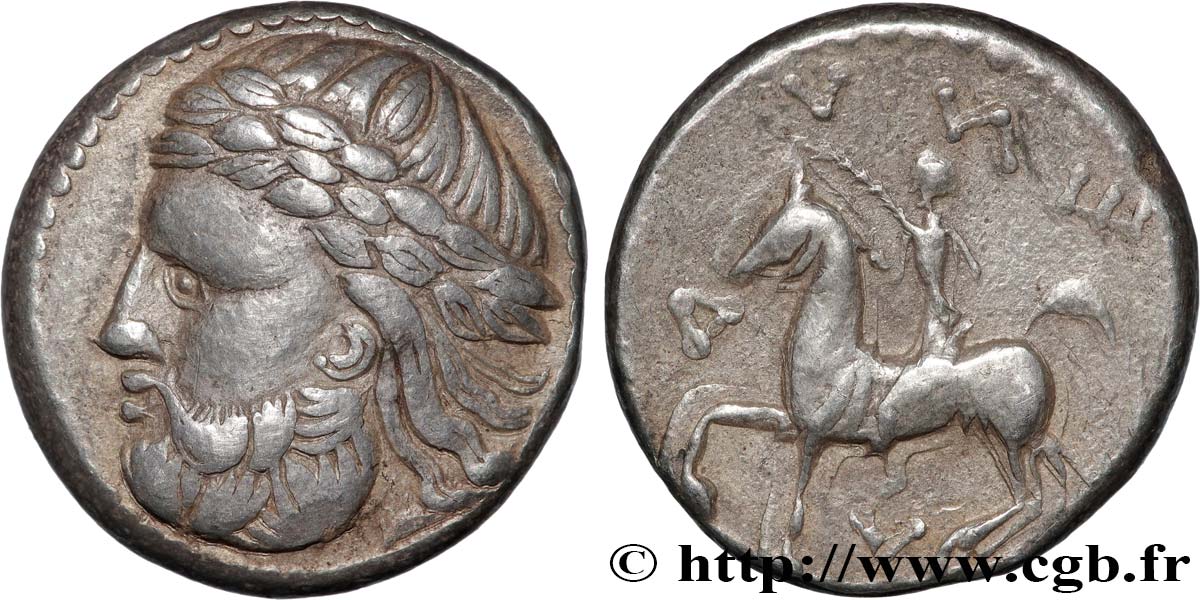
Belle monnaie sur un flan épais et centré. Très beau portrait de Zeus au droit, finement détaillé. Revers tréflé. Patine grise
Ссылки в каталоге: :
Происхождение:
Cet exemplaire provient de la collection Norbert Michaud, fameux collectionneur d’art japonais
Лицевая сторона
Аверс: легенда: ANÉPIGRAPHE.
Аверс: описание: Tête laurée de Zeus à gauche, grènetis.
Обратная сторона
Реверс: Описание: Cavalier au pas à gauche, tenant une palme de la main droite ; le cheval lève l'antérieur à droite ; légende dégénérée autour du cheval.
Реверс: легенда: FILIP - POU
Комментарий
Cet exemplaire est celui de MONNAIES 28, n° 688. Ce tétradrachme semble être des mêmes coins que le n° 688 de MONNAIES 28 et du n° 3 de la vente LANZ 154. Mis à part ces exemplaires, ce type précis semble manquer à tous les ouvrages et catalogues de musées consultés.
Si le statère d’or de Philippe II de Macédoine a servi de prototype à de nombreuses imitations gauloises, le tétradrachme n’a pas été imité en Gaule, mais reste principal sujet d’inspiration des monnaies pour les Celtes du Danube (LT. 9697-9767, 9768-9832, 9618-9630, 9870-9886). Les premières imitations furent frappées dans le premier quart du IIIe siècle avant J.-C. La fabrication des copies serviles, puis des imitations, enfin des frappes celtiques continuèrent pendant plus de deux siècles.
This example is that of MONNAIES 28, n° 688. This tetradrachm seems to be from the same dies as n° 688 of MONNAIES 28 and n° 3 of the LANZ 154 sale. Apart from these examples, this precise type seems to be missing from all works and museum catalogs consulted. If the gold stater of Philip II of Macedonia served as a prototype for numerous Gallic imitations, the tetradrachm was not imitated in Gaul, but remained the main subject of inspiration for the coins of the Celts of the Danube (LT. 9697 -9767, 9768-9832, 9618-9630, 9870-9886). The first imitations were struck in the first quarter of the 3rd century BC. The manufacture of servile examples, then imitations, and finally Celtic mintings continued for more than two centuries.
Si le statère d’or de Philippe II de Macédoine a servi de prototype à de nombreuses imitations gauloises, le tétradrachme n’a pas été imité en Gaule, mais reste principal sujet d’inspiration des monnaies pour les Celtes du Danube (LT. 9697-9767, 9768-9832, 9618-9630, 9870-9886). Les premières imitations furent frappées dans le premier quart du IIIe siècle avant J.-C. La fabrication des copies serviles, puis des imitations, enfin des frappes celtiques continuèrent pendant plus de deux siècles.
This example is that of MONNAIES 28, n° 688. This tetradrachm seems to be from the same dies as n° 688 of MONNAIES 28 and n° 3 of the LANZ 154 sale. Apart from these examples, this precise type seems to be missing from all works and museum catalogs consulted. If the gold stater of Philip II of Macedonia served as a prototype for numerous Gallic imitations, the tetradrachm was not imitated in Gaul, but remained the main subject of inspiration for the coins of the Celts of the Danube (LT. 9697 -9767, 9768-9832, 9618-9630, 9870-9886). The first imitations were struck in the first quarter of the 3rd century BC. The manufacture of servile examples, then imitations, and finally Celtic mintings continued for more than two centuries.
Историческая справка
DANUBIAN CELTS - IMITATIONS OF THE TETRADRACHMS OF PHILIP II AND HIS SUCCESSORS
(3rd-1st century BC)
Under this title are generally grouped all the coinages that do not have a precise attribution. Sometimes the term "Eastern Celts" is offered. After the Celts plundered Delphi and spread through Greece and Asia Minor, they seized a significant amount of spoils, thanks to their plunder. The Hellenistic kings, Diadoques or Epigones, used them as mercenaries in their armies where the average salary was normally one stater of gold corresponding to five tetradrachms of Attic standard or twenty drachms. The prototypes which represented the head of Zeus with a horseman were widely copied and imitated throughout the Balkans, northern Macedonia and Thrace. The final phase of the coinage occurs at the end of the 2nd century or the beginning of the first century BC where there are no traces of the obverse and the reverse as well as legends more than a domed face of a coin. practically smooth on both sides.
 Cообщить об ошибке
 Распечатать страницу
 Отправить мой выбор
 Задать вопрос
 Consign / sell
ПОХОЖИЕ ТОВАРЫ
 Информация



cgbfr.com для нумизматов


