


bpv_304976 - DOMITIANUS Tétradrachme syro-phénicien

недоступный.
Товар уже продан в нашем интернет-магазине (2015)
Цена: : 550.00 €
Товар уже продан в нашем интернет-магазине (2015)
Цена: : 550.00 €
Тип Tétradrachme syro-phénicien
Дата: 88-89
Монетный двор / Город: Antioche, Syrie, Séleucie et Piérie
Металл: silver
Диаметр: 26,00 mm
Ориентация осей монеты: 12 h.
Вес: 14,48 g.
Комментарии о состоянии
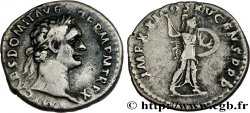
Style magnifique avec un très beau portrait de haut relief et un aigle hiératique. Le décentré du droit met en valeur le portrait
Ссылки в каталоге: :
Происхождение:
Cet exemplaire est le 0145_004 de la base TSP, il provient de la vente Hess 252, 1982, n° 251 puis de la vente Vecchi N°10, (10 10 1983), n° 321 puis de la collection Richard McAlee dont il illustre le type dans son livre Coins of Roman Antioch
Лицевая сторона
Аверс: описание: Tête laurée de Domitien à droite avec l’égide nouvelle sur la poitrine (O*4).
Аверс: легенда: AUT KAISAR DOMITIANOS SEB GERM (Autokrtor Kaisaros Domitianos Sebastos Germanikos)
Аверс: перевод: (L'empereur césar Domitien auguste germanique).
Обратная сторона
Реверс: Описание: Aigle debout à droite sur un foudre, les ailes déployées ; une palme dans le champ à droite.
Реверс: легенда: ETOUS - NEOU IEROU - H, (Etous Neou Ierou H)
Реверс: перевод: (année sainte huitième du règne).
Комментарий
L’an 8 marque une vraie renaissance de l’atelier d’Antioche, tant pour les quantités frappées, qui rejoignent les niveaux d’une frappe de circulation, que pour le style et même, pour autant que l’on puisse en juger par l’aspect du métal, pour la pureté de l’aloi utilisé.
Sur le plan stylistique, l’événement est l’arrivée d’un grand graveur, la disparition de l’égide ancienne à la peau de chèvre et au serpent, et l’apparition de l’égide moderne, la tête de Méduse ailée de profil sur la poitrine.
Bien entendu, on peut supposer une lien psychologique dans l’Antiquité entre la beauté et l’aspect de la monnaie et la confiance qui lui était accordée. Sur ce plan, les frappes des an 2 et 7 de Domitien étaient handicapés par l’aspect alexandrin du style et du métal : tout le monde devait savoir que le monnayage égyptien était en bas titre.
Cinquante trois exemplaires sont maintenant répertoriés dans la base TSP, avec, en musées, Paris, Berlin, ANS, British Museum (2), Glasgow Hunterian, Yale (2), Oxford et Jérusalem.
The year 8 marks a true renaissance of the Antioch mint, both for the quantities struck, which reach the levels of a circulation strike, and for the style and even, as far as one can judge by the appearance of the metal, for the purity of the alloy used. Stylistically, the event is the arrival of a great engraver, the disappearance of the ancient aegis with goatskin and snake, and the appearance of the modern aegis, the winged head of Medusa in profile on the chest. Of course, one can suppose a psychological link in Antiquity between the beauty and appearance of the coin and the confidence placed in it. In this respect, the strikes of the years 2 and 7 of Domitian were handicapped by the Alexandrian aspect of the style and the metal: everyone must have known that Egyptian coinage was of low fineness. Fifty-three examples are now listed in the TSP database, with, in museums, Paris, Berlin, ANS, British Museum (2), Glasgow Hunterian, Yale (2), Oxford and Jerusalem
Sur le plan stylistique, l’événement est l’arrivée d’un grand graveur, la disparition de l’égide ancienne à la peau de chèvre et au serpent, et l’apparition de l’égide moderne, la tête de Méduse ailée de profil sur la poitrine.
Bien entendu, on peut supposer une lien psychologique dans l’Antiquité entre la beauté et l’aspect de la monnaie et la confiance qui lui était accordée. Sur ce plan, les frappes des an 2 et 7 de Domitien étaient handicapés par l’aspect alexandrin du style et du métal : tout le monde devait savoir que le monnayage égyptien était en bas titre.
Cinquante trois exemplaires sont maintenant répertoriés dans la base TSP, avec, en musées, Paris, Berlin, ANS, British Museum (2), Glasgow Hunterian, Yale (2), Oxford et Jérusalem.
The year 8 marks a true renaissance of the Antioch mint, both for the quantities struck, which reach the levels of a circulation strike, and for the style and even, as far as one can judge by the appearance of the metal, for the purity of the alloy used. Stylistically, the event is the arrival of a great engraver, the disappearance of the ancient aegis with goatskin and snake, and the appearance of the modern aegis, the winged head of Medusa in profile on the chest. Of course, one can suppose a psychological link in Antiquity between the beauty and appearance of the coin and the confidence placed in it. In this respect, the strikes of the years 2 and 7 of Domitian were handicapped by the Alexandrian aspect of the style and the metal: everyone must have known that Egyptian coinage was of low fineness. Fifty-three examples are now listed in the TSP database, with, in museums, Paris, Berlin, ANS, British Museum (2), Glasgow Hunterian, Yale (2), Oxford and Jerusalem
Историческая справка
DOMITIANUS
(12/69-18/09/96)
Augustus
Domitian, born in 51, became august in 81, succeeding his brother. In 86, the Capitoline games were organized for the first time. The Flavian Palace is erected on the Palatine. In 88, the secular games were celebrated with pomp. A first campaign is launched on Dacia which ends with a peace of compromise, leaving Decebalus master of the situation. Domitian has just won a brilliant campaign against the Sarmatians and the Suevi (IMP XXII). Agricola died in disgrace on August 23, 93. In 95, Domitian had Flavius Clemens, his cousin, executed. The following year, Domitian will be assassinated at the instigation of his wife and the prefect of the Praetorium.
 Cообщить об ошибке
 Распечатать страницу
 Отправить мой выбор
 Задать вопрос
 Consign / sell
 Информация


Your Recently Viewed Items
CLAUDIUS II GOTHICUS Antoninien XF
25.00 €
AUSTRALIA 25 cents Kangourou Proof 2017 MS
40.00 €
cgbfr.com для нумизматов


