


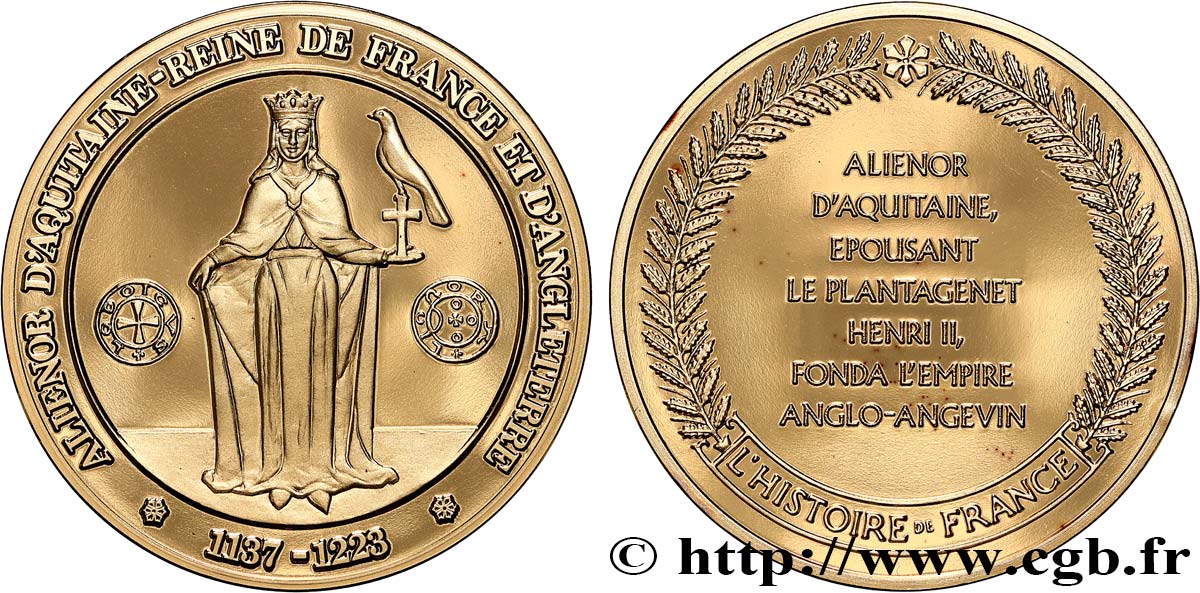
fme_620855 - HISTOIRE DE FRANCE Médaille, La reine Aliénor
недоступный.
Товар уже продан в нашем интернет-магазине (2021)
Цена: : 45.00 €
Товар уже продан в нашем интернет-магазине (2021)
Цена: : 45.00 €
Тип Médaille, La reine Aliénor
Дата: (1974)
Металл: gold plated silver
Диаметр: 44 mm
Ориентация осей монеты: 12 h.
Вес: 38,40 g.
Век: lisse + losange VERMEIL 74-P + 307
Комментарии о состоянии
Traces de manipulation. Exemplaire dans une capsule
Лицевая сторона
Аверс: легенда: ALIENOR D’AQUITAINE - REINE DE FRANCE ET D’ANGLETERRE // 1137-1223.
Аверс: описание: La reine Aliénor en pied, tenant un oiseau posé sur une croix de la main gauche ; deux monnaies médiévales de part et d’autre.
Обратная сторона
Реверс: легенда: ALIENOR / D’AQUITAINE / EPOUSANT / LE PLANTAGENET / HENRI II, / FONDA L’EMPIRE / ANGLO-ANGEVIN // L’HISTOIRE DE FRANCE.
Реверс: Описание: Légende en 7 lignes horizontales dans une couronne végétale partant d’un cartouche à l’exergue.
Комментарий
Médaille de la série Histoire de France, numéro du souscripteur : 307
Aliénor d’Aquitaine, aussi connue sous le nom de Éléonore d'Aquitaine ou de Guyenne, née vers 1122 ou 1124, et morte le 31 mars ou le 1er avril 1204, à Poitiers et non à l'abbaye de Fontevraud, a été tour à tour reine des Francs, puis reine consort d'Angleterre.
Duchesse d’Aquitaine et comtesse de Poitiers, elle occupe une place centrale dans les relations au XIIe siècle entre les royaumes de France et d’Angleterre : elle épouse successivement le roi de France Louis VII (1137), puis Henri Plantagenêt (1152), futur roi d’Angleterre Henri II, renversant ainsi le rapport des forces en apportant ses terres à l’un puis à l’autre des deux souverains. À la cour fastueuse qu'elle tient en Aquitaine, elle favorise l'expression poétique des troubadours en langue d'oc. À compter de son premier mariage (pendant lequel elle a participé à la deuxième croisade), elle joue un rôle politique important dans l’Europe médiévale..
Medal from the History of France series, subscriber number: 307 Eleanor of Aquitaine, also known as Eleanor of Aquitaine or Guyenne, born around 1122 or 1124, and died on March 31 or April 1, 1204, in Poitiers and not at the Abbey of Fontevraud, was in turn Queen of the Franks, then Queen consort of England. Duchess of Aquitaine and Countess of Poitiers, she occupied a central place in the relations in the 12th century between the kingdoms of France and England: she married successively the King of France Louis VII (1137), then Henry Plantagenet (1152), future King of England Henry II, thus reversing the balance of power by bringing her lands to one then to the other of the two sovereigns. At the lavish court she held in Aquitaine, she encouraged the poetic expression of the troubadours in the langue d'oc. From her first marriage (during which she participated in the Second Crusade), she played an important political role in medieval Europe.
Aliénor d’Aquitaine, aussi connue sous le nom de Éléonore d'Aquitaine ou de Guyenne, née vers 1122 ou 1124, et morte le 31 mars ou le 1er avril 1204, à Poitiers et non à l'abbaye de Fontevraud, a été tour à tour reine des Francs, puis reine consort d'Angleterre.
Duchesse d’Aquitaine et comtesse de Poitiers, elle occupe une place centrale dans les relations au XIIe siècle entre les royaumes de France et d’Angleterre : elle épouse successivement le roi de France Louis VII (1137), puis Henri Plantagenêt (1152), futur roi d’Angleterre Henri II, renversant ainsi le rapport des forces en apportant ses terres à l’un puis à l’autre des deux souverains. À la cour fastueuse qu'elle tient en Aquitaine, elle favorise l'expression poétique des troubadours en langue d'oc. À compter de son premier mariage (pendant lequel elle a participé à la deuxième croisade), elle joue un rôle politique important dans l’Europe médiévale..
Medal from the History of France series, subscriber number: 307 Eleanor of Aquitaine, also known as Eleanor of Aquitaine or Guyenne, born around 1122 or 1124, and died on March 31 or April 1, 1204, in Poitiers and not at the Abbey of Fontevraud, was in turn Queen of the Franks, then Queen consort of England. Duchess of Aquitaine and Countess of Poitiers, she occupied a central place in the relations in the 12th century between the kingdoms of France and England: she married successively the King of France Louis VII (1137), then Henry Plantagenet (1152), future King of England Henry II, thus reversing the balance of power by bringing her lands to one then to the other of the two sovereigns. At the lavish court she held in Aquitaine, she encouraged the poetic expression of the troubadours in the langue d'oc. From her first marriage (during which she participated in the Second Crusade), she played an important political role in medieval Europe.
Историческая справка
HISTOIRE DE FRANCE
(1974-1982)
The history of France in medals is a production issued by the company Le Médaillier, whose president was Patrick Petit. The medals were generally of "Epreuve" quality, in vermeil. The edge of each of the medals bears the State hallmark, the medal maker's hallmark, the year of minting, the Proof mark and the subscriber's personal printing number.
 Cообщить об ошибке
 Распечатать страницу
 Отправить мой выбор
 Задать вопрос
 Consign / sell
ПОХОЖИЕ ТОВАРЫ
 Информация

Your Recently Viewed Items
ITALY - PAPAL STATES - CLEMENT XII (Lorenzo Corsini) Teston 1735 Rome AU
252.00 €
cgbfr.com для нумизматов


