


fme_690870 - THE 100 GREATEST MASTERPIECES Médaille, Auguste de Prima Porta
недоступный.
Товар уже продан в нашем интернет-магазине (2021)
Цена: : 55.00 €
Товар уже продан в нашем интернет-магазине (2021)
Цена: : 55.00 €
Тип Médaille, Auguste de Prima Porta
Дата: 1981
Металл: silver
Проба: 800 ‰
Диаметр: 50,5 mm
Ориентация осей монеты: 12 h.
Гравер SCHROEDER Georgann
Вес: 65,89 g.
Век: lisse + ARGENT 1ER TITRE + losange + 81-P + CRABE
Пуансон: Crabe
Комментарии о состоянии
Traces de manipulation et d’oxydation irisée et cuivrée sur la tranche et le dessus de la médaille
Лицевая сторона
Аверс: легенда: ANÉPIGRAPHE.
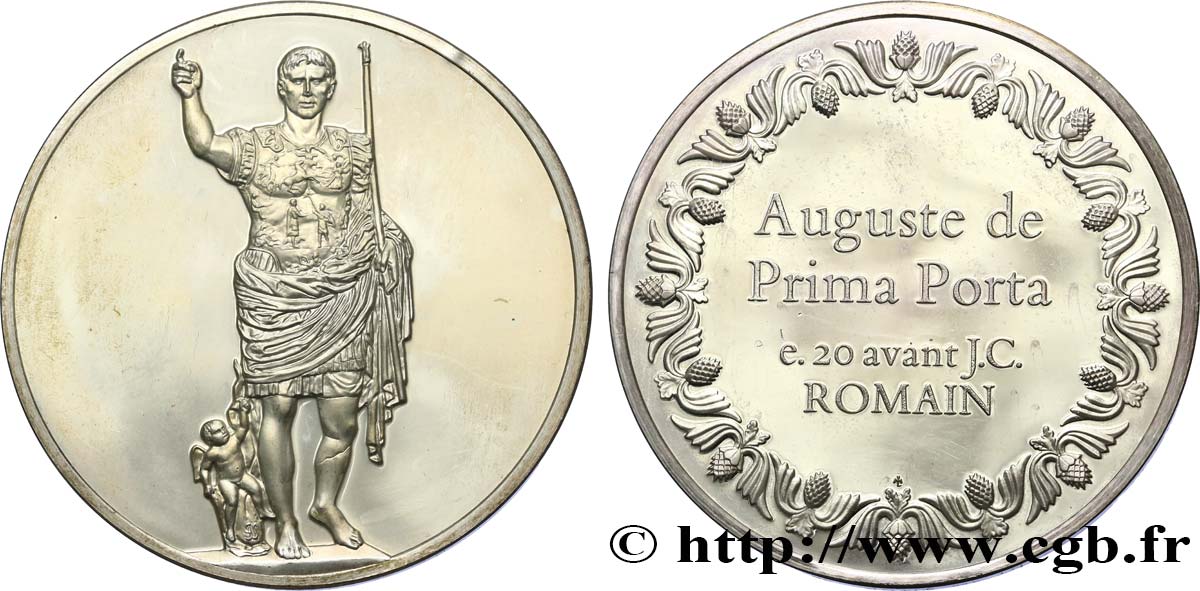
Аверс: описание: Représentation d’une statue romaine (e. 20 av. J.-C).
Monogramme du graveur.
Обратная сторона
Реверс: легенда: AUGUSTE DE / PRIMA PORTA / E.20 AVANT J.C. / ROMAIN.
Реверс: Описание: Légende en 4 lignes entourée d’une frise végétale.
Комментарий
Exemplaire issu du médaillier Franklin qui met à l’honneur une statue d’Auguste, empereur romain :Cette statue représente Auguste en imperator. Il porte une tunique courte, une cuirasse et le paludamentum (manteau pourpre). Il a la tête et les pieds nus.
Il est représenté sous les traits d’un homme mûr de quarante-trois ans.
Il adopte ici le chiasme : il s’appuie sur sa jambe droite et a la jambe gauche en arrière (contrapposto : le poids du corps repose sur une seule jambe).
La représentation d’Auguste s’inspire, sans être une imitation, de l’attitude d'une sculpture grecque, Doryphore de Polyclète. Cela lui donne une position moins statique que s’il avait les deux pieds collés. À ses pieds se trouve un petit éros chevauchant un dauphin.
La statue étant une copie d’une statue en bronze, le sculpteur a dû rajouter un support (le dauphin) pour consolider la statue. On retrouve cela fréquemment sur les statues en marbre.
Le sceptre qu’il tient dans la main gauche est une restauration moderne et doit avoir remplacé une lance ou peut être les enseignes. Le bras droit levé horizontalement est également moderne.
L’attitude est celle du discours autoritaire et calme. Cette statue représente l’imperator haranguant ses soldats après la victoire. C’est ainsi que devaient être représentés les hommes politiques et militaires romains depuis l'Arringatore étrusco-romain.
Dans l'Antiquité, toutes les statues et monuments étaient peints, mais la couleur a disparu. Les chercheurs ont retrouvé des pigments de couleur sur la statue et proposent des représentations peintes.
Cette statue est conservée au musée du Vatican en Italie.
Médaille sculptée par Georgann Schroeder.
Théoriquement, le poinçon crabe est censé indiquer un titrage à 800 millièmes.
example from the Franklin medalist which features a statue of Augustus, Roman emperor: This statue represents Augustus as imperator. He wears a short tunic, a breastplate and the paludamentum (purple cloak). He has bare head and feet.
He is depicted as a mature man of forty-three years old.
Here he adopts the chiasmus: he leans on his right leg and has his left leg behind (contrapposto: the weight of the body rests on one leg only).
The representation of Augustus is inspired, without being an imitation, by the attitude of a Greek sculpture, Doryphoros by Polyclitus.. This gives him a less static position than if he had both feet together. At his feet is a small Eros riding a dolphin.
The statue being a example of a bronze statue, the sculptor had to add a support (the dolphin) to consolidate the statue. This is frequently found on marble statues..
The scepter he holds in his left hand is a modern restoration and must have replaced a lance or perhaps the ensigns. The right arm raised horizontally is also modern.
The attitude is that of authoritative and calm speech. This statue represents the imperator haranguing his soldiers after the victory. This is how Roman politicians and military men had to be represented since the Etruscan-Roman Arringatore.
In ancient times, all statues and monuments were painted, but the color has disappeared. Researchers found colored pigments on the statue and propose painted representations.
This statue is kept in the Vatican Museum in Italy.
Medal sculpted by Georgann Schroeder.
Theoretically, the crab hallmark is supposed to indicate a fineness of 800 thousandths.
Il est représenté sous les traits d’un homme mûr de quarante-trois ans.
Il adopte ici le chiasme : il s’appuie sur sa jambe droite et a la jambe gauche en arrière (contrapposto : le poids du corps repose sur une seule jambe).
La représentation d’Auguste s’inspire, sans être une imitation, de l’attitude d'une sculpture grecque, Doryphore de Polyclète. Cela lui donne une position moins statique que s’il avait les deux pieds collés. À ses pieds se trouve un petit éros chevauchant un dauphin.
La statue étant une copie d’une statue en bronze, le sculpteur a dû rajouter un support (le dauphin) pour consolider la statue. On retrouve cela fréquemment sur les statues en marbre.
Le sceptre qu’il tient dans la main gauche est une restauration moderne et doit avoir remplacé une lance ou peut être les enseignes. Le bras droit levé horizontalement est également moderne.
L’attitude est celle du discours autoritaire et calme. Cette statue représente l’imperator haranguant ses soldats après la victoire. C’est ainsi que devaient être représentés les hommes politiques et militaires romains depuis l'Arringatore étrusco-romain.
Dans l'Antiquité, toutes les statues et monuments étaient peints, mais la couleur a disparu. Les chercheurs ont retrouvé des pigments de couleur sur la statue et proposent des représentations peintes.
Cette statue est conservée au musée du Vatican en Italie.
Médaille sculptée par Georgann Schroeder.
Théoriquement, le poinçon crabe est censé indiquer un titrage à 800 millièmes.
example from the Franklin medalist which features a statue of Augustus, Roman emperor: This statue represents Augustus as imperator. He wears a short tunic, a breastplate and the paludamentum (purple cloak). He has bare head and feet.
He is depicted as a mature man of forty-three years old.
Here he adopts the chiasmus: he leans on his right leg and has his left leg behind (contrapposto: the weight of the body rests on one leg only).
The representation of Augustus is inspired, without being an imitation, by the attitude of a Greek sculpture, Doryphoros by Polyclitus.. This gives him a less static position than if he had both feet together. At his feet is a small Eros riding a dolphin.
The statue being a example of a bronze statue, the sculptor had to add a support (the dolphin) to consolidate the statue. This is frequently found on marble statues..
The scepter he holds in his left hand is a modern restoration and must have replaced a lance or perhaps the ensigns. The right arm raised horizontally is also modern.
The attitude is that of authoritative and calm speech. This statue represents the imperator haranguing his soldiers after the victory. This is how Roman politicians and military men had to be represented since the Etruscan-Roman Arringatore.
In ancient times, all statues and monuments were painted, but the color has disappeared. Researchers found colored pigments on the statue and propose painted representations.
This statue is kept in the Vatican Museum in Italy.
Medal sculpted by Georgann Schroeder.
Theoretically, the crab hallmark is supposed to indicate a fineness of 800 thousandths.
Историческая справка
THE 100 GREATEST MASTERPIECES
(1974-1982)
Collection of medals issued by the Medallier in a limited edition. Once a month, at the price of 180 Frs, a medal was sent. This collection took place between 1974 and 1982. Each medal normally bears on the edge the state hallmark guaranteeing the silver mintage, the P mark for the Proof quality, the year of minting and the hallmark of Master of the Medallion..
 Cообщить об ошибке
 Распечатать страницу
 Отправить мой выбор
 Задать вопрос
 Consign / sell
 Информация
cgbfr.com для нумизматов


