


fjt_049462 - LOUIS XIV LE GRAND ou LE ROI SOLEIL Révocation de l’Edit de Nantes 1685

недоступный.
Товар уже продан в нашем интернет-магазине
Цена: : 57.93 €
Товар уже продан в нашем интернет-магазине
Цена: : 57.93 €
Тип Révocation de l’Edit de Nantes
Дата: 1685
Металл: red copper
Диаметр: 41 mm
Век: lisse, poinçon (abeille)
Пуансон: Abeille (1860 - 1880)
Ссылки в каталоге: :
Лицевая сторона
Аверс: легенда: LUDOVICUS MAGNUS REX CHRISTIANISSIMUS.
Аверс: описание: Buste de Louis XIV à droite, signé DOLLIN. F.
Аверс: перевод: Louis le Grand, roi très chrétien.
Обратная сторона
Реверс: легенда: EXTINCTA HAERESIS.
Реверс: Описание: La Religion debout, tenant une croix et tenant le livre des Evangiles. A ses pieds l’Hérésie, représentée par une figure terrassée. Au fond le portail d’une église ; à l’exergue : EDICTUM OCTOBRIA / M. DC. LXXXV.
Комментарий
L’Édit de Nantes (1598) avait assuré la liberté religieuse aux protestants français. L’acte de Révocation, médité et corrigé maintes fois par le roi, fut signé le 18 octobre. L’Édit de Fontainebleau ordonnait la démolition des temples calvinistes et la cessation des exercices, la fermeture des écoles protestantes, l’exil des ministres qui ne voudraient pas se convertir et la peine de galères pour tout sujet qui sortirait du royaume. Plus de 200 000 Français s’exilèrent, parmi lesquels des magistrats et des savants, des soldats et des artisans qui renonçaient à leur patrie pour ne pas renier leur foi. Beaucoup allaient en Allemagne, tout particulièrement en Prusse, où l’électeur les accueillit à bras ouverts. Les émigrés créèrent à l’étranger des industries où la France avait jusqu’alors la prééminence. Pour la France, c’était une élite qui fut perdue et il en résulta une crise économique et sociale.
The Edict of Nantes (1598) had guaranteed religious freedom to French Protestants. The Act of Revocation, considered and amended many times by the king, was signed on October 18. The Edict of Fontainebleau ordered the demolition of Calvinist churches and the cessation of religious exercises, the closure of Protestant schools, the exile of ministers who refused to convert, and the galley punishment for any subject who left the kingdom. More than 200,000 French people went into exile, including magistrates and scholars, soldiers, and artisans who renounced their homeland so as not to renounce their faith. Many went to Germany, especially Prussia, where the Elector welcomed them with open arms. The émigrés created industries abroad where France had previously held preeminence. For France, it was an elite that was lost and the result was an economic and social crisis.
The Edict of Nantes (1598) had guaranteed religious freedom to French Protestants. The Act of Revocation, considered and amended many times by the king, was signed on October 18. The Edict of Fontainebleau ordered the demolition of Calvinist churches and the cessation of religious exercises, the closure of Protestant schools, the exile of ministers who refused to convert, and the galley punishment for any subject who left the kingdom. More than 200,000 French people went into exile, including magistrates and scholars, soldiers, and artisans who renounced their homeland so as not to renounce their faith. Many went to Germany, especially Prussia, where the Elector welcomed them with open arms. The émigrés created industries abroad where France had previously held preeminence. For France, it was an elite that was lost and the result was an economic and social crisis.
Историческая справка
LOUIS XIV THE GREAT or THE SUN KING
(14/05/1643-1/09/1715)
The reign of Louis XIV is the longest and most glorious in the history of France. Son of Louis XIII and Anne of Austria, born September 5, 1638, the third Bourbon king ascended the throne in 1643 and remained there for seventy-three years. He died on September 1, 1715, aged seventy-seven.. Between 1643 and 1661, under the regency of Anne of Austria and the ministry of Cardinal Mazarin, absolutism was built through combat: internal struggle against the Fronde, external struggle against Spain. The personal reign of Louis XIV began in 1661, when the young king decided to "govern by himself".. The absolute monarchy then reached its peak, the king being surrounded by a team of exceptional ministers: Le Tellier, Louvois, Colbert, Seignelay. This prosperous period ended during the 1680s, with the first setbacks, the revocation of the Edict of Nantes (1685), the end of the great external successes and the gradual disappearance of the entourage of the first years (Colbert died in 1683 , Le Tellier in 1685, Seignelay in 1690, Louvois in 1691). The third and last part of the reign, between 1685 and 1715, is more difficult. The aging king finds no similar collaborators. Glorious, this reign was first a warlike reign. Never has France known so many wars: the Thirty Years' War, completed with the Empire in 1648, with Spain only in 1659, War of Devolution (1667-1668), War of Holland (1672-1678), war with Spain (1684), War of the League of Augsburg (1688-1697), War of the Spanish Succession (1701-1713). She never knew more victories and more conquests: in 1648, the treaties of Westphalia gave her Alsace, in 1659, the peace of the Pyrenees, Artois and Roussillon; in 1668, by the Peace of Aix-la-Chapelle, it reached Flanders; in 1678, by the Treaty of Nijmegen, Franche-Comté. In 1681, the king annexed Strasbourg. The following decades were less happy: in 1697 (Treaty of Ryswick), France ceded Luxembourg; in 1713 and 1714 (treaties of Utrecht and Rastadt), she abandoned Acadia, a prelude to the loss of America, fifty years later. The reign of Louis XIV therefore corresponds quite exactly to the age of French preponderance in Europe: France supplanted Spain; it will soon be supplanted by England, which holds the empire of the seas and the expanses of the New World. To the glory of the victorious and conquering king is added the glory of the king administrator, legislator, protector of arts and letters. Louis XIV and his ministers gave perfection to the construction of the monarchy: the legislation was reformed, the nobility subdued, the provinces tamed, heresy overthrown, artists and writers put themselves at the service of royal power. Lex una sub uno sole: "a single law under a single sun": everything must revolve around the star-master. The whole of Europe feels the attraction and prestige of Versailles. The reality is undoubtedly less brilliant than this flattering program: the royal administration remains too small to really frame the largest and most populous kingdom in Europe; particularisms resist; the Protestants leave to enrich the enemies of France. The fact remains that it is the image of the king of glory that has imposed itself in the memories, as Louis XIV had decided and wanted it.. There lies the true triumph of this prince: for France and for Europe, for the following century and for centuries to come, for contemporaries as for posterity, he was and remains the King par excellence.. Coins and medals, which restore to us the Jupiterian profile of the great monarch, are part of this will and this success.. Louis XIV paid particular attention to them: the Grand Siècle is also a great century of numismatics.
 Cообщить об ошибке
 Распечатать страницу
 Отправить мой выбор
 Задать вопрос
 Consign / sell
ПОХОЖИЕ ТОВАРЫ

 Информация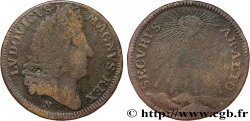


cgbfr.com для нумизматов


