


brm_178022 - NAEVIA Denier serratus

недоступный.
Товар уже продан в нашем интернет-магазине
Цена: : 45.00 €
Товар уже продан в нашем интернет-магазине
Цена: : 45.00 €
Тип Denier serratus
Дата: 79 AC.
Монетный двор / Город: Rome ou Italie
Металл: silver
Проба: 950 ‰
Диаметр: 18,5 mm
Ориентация осей монеты: 5 h.
Вес: 3,34 g.
Комментарии о состоянии
Exemplaire à l’usure régulière. A été nettoyé. Droit décentré
Ссылки в каталоге: :
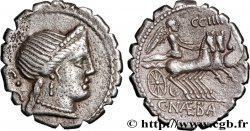
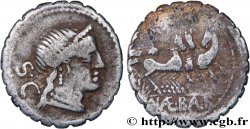
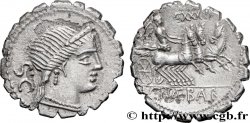
Лицевая сторона
Аверс: легенда: S. C.
Аверс: описание: Tête diadémée de Vénus à droite ; marque de contrôle A.
Аверс: перевод: “Senatus Consulto”, (avec l’accord du Sénat).
Обратная сторона
Реверс: легенда: CNÆ B(AL)B.
Реверс: Описание: Victoire dans un trige galopant à droite, tenant les rênes des deux mains à gauche ; au-dessus, marque de contrôle VII, (7).
Реверс: перевод: “Cnæus [Nævius] Balbus”, (Gneius [Nævius] Balbus).
Комментарий
Poids léger. La représentation du trige est aussi rare dans les numismatiques gauloise que romaine. On trouve dans l'ouvrage de LA TOUR (LT. 10074, 10075 et 10085), les dessins de trois deniers copiés ou imités sur ce prototype par les Celtes du Danube. D'autre part, S. Scheers donne comme prototype du bronze véliocasse (LT. 7356), le denier de Jules César (RCV. 1402) avec Énée fuyant Troie. En réalité, la tête de Vénus de notre denier semble assez proche de celle du bronze et pourrait lui avoir servi de modèle.
Light weight. The representation of the trige is as rare in Gallic as in Roman numismatics. In the work of LA TOUR (LT. 10074, 10075 and 10085), we find the drawings of three denarii copied or imitated on this prototype by the Celts of the Danube. On the other hand, S. Scheers gives as prototype of the bronze veliocasses (LT. 7356), the denarius of Julius Caesar (RCV. 1402) with Aeneas fleeing Troy. In reality, the head of Venus of our denarius seems quite close to that of the bronze and could have served as a model for it
Light weight. The representation of the trige is as rare in Gallic as in Roman numismatics. In the work of LA TOUR (LT. 10074, 10075 and 10085), we find the drawings of three denarii copied or imitated on this prototype by the Celts of the Danube. On the other hand, S. Scheers gives as prototype of the bronze veliocasses (LT. 7356), the denarius of Julius Caesar (RCV. 1402) with Aeneas fleeing Troy. In reality, the head of Venus of our denarius seems quite close to that of the bronze and could have served as a model for it
Историческая справка
NAEVIA
(79 BC)
The Naevia gens is a family of plebeian and patrician origin. Caius Naevius Balbus, the moneyer, is a supporter of Sulla.
 Cообщить об ошибке
 Распечатать страницу
 Отправить мой выбор
 Задать вопрос
 Consign / sell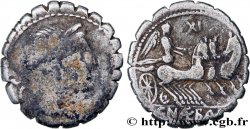
 Информация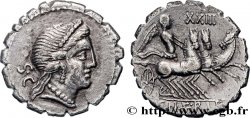

Your Recently Viewed Items

10 Pesos Consécutifs MEXICO 1915 PS.0535a AU+
60.00 €
cgbfr.com для нумизматов


