


v16_0622 - FILIPPO II FIGLIO Tétradrachme syro-phénicien
MONNAIES 16 (2002)
Начальная цена : 100.00 €
Назначить цену : 180.00 €
Цена реализации : 212.00 €
Количество ставок : 3
Максимальная предлагаемая цена : 212.00 €
Начальная цена : 100.00 €
Назначить цену : 180.00 €
Цена реализации : 212.00 €
Количество ставок : 3
Максимальная предлагаемая цена : 212.00 €
Тип Tétradrachme syro-phénicien
Дата: 249
Монетный двор / Город: Antioche, Syrie, Séleucie et Piérie
Металл: billon
Диаметр: 27,5 mm
Ориентация осей монеты: 6 h.
Вес: 10,85 g.
Редкость: R1
Комментарии о состоянии
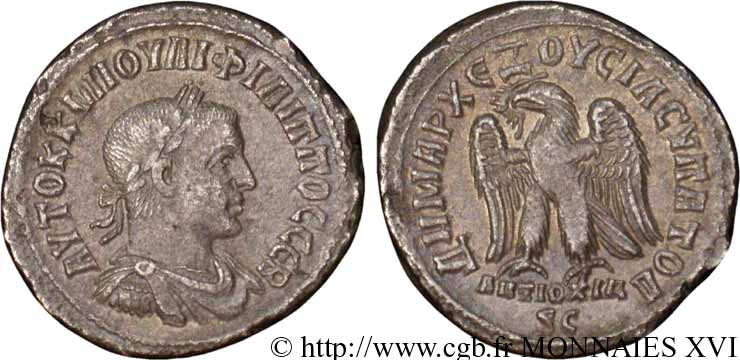
Beau portrait. Flan large et complet des deux côtés. Patine grise avec reflets roses
Ссылки в каталоге: :
Prieur 466 (29 ex.)
Происхождение:
Cet exemplaire est le 0466_026 de la base TSP
Лицевая сторона
Аверс: описание: Buste lauré, drapé et cuirassé de Philippe II auguste à droite, vu de trois quarts en avant, ptéryges bien visibles (A*).
Аверс: легенда: AUTOK K M IOULI FILIPPOS SEB
Аверс: перевод: (L’empereur césar Marc Jules Philippe auguste).
Обратная сторона
Реверс: легенда: ANTIOXIA/ SC À L’EXERGUE EN DEUX LIGNES.
Реверс: Описание: Aigle debout à gauche, les ailes déployées, tenant une couronne dans son bec.
Реверс: легенда: DHMARC EX OUSIAS UPATO D
Реверс: перевод: (Revêtu de la puissance tribunitienne consul pour la quatrième fois).
Комментарий
La légende de revers concerne en fait Philippe Ier qui ne prit jamais de quatrième consulat, à Rome le dernier, le troisième datant de 248. Il semble que le comput antiochéen ait été différent pour des raisons qui nous échappent totalement et M. Prieur date pour cette raison ces tétradrachmes de Philippe l’Arabe ou de son fils de 249. L’émission semble avoir été conséquente et présente de multiples variantes de portraits que l’on retrouve aussi bien sur les grands bronzes que sur les tétradrachmes.
The reverse legend actually concerns Philip I who never took a fourth consulate, in Rome the last, the third dating from 248. It seems that the Antiochene calculation was different for reasons that completely escape us and Mr. Prieur dates for this reason these tetradrachms of Philip the Arab or his son from 249. The issue seems to have been substantial and presents multiple variants of portraits that are found both on the large bronzes and on the tetradrachms
The reverse legend actually concerns Philip I who never took a fourth consulate, in Rome the last, the third dating from 248. It seems that the Antiochene calculation was different for reasons that completely escape us and Mr. Prieur dates for this reason these tetradrachms of Philip the Arab or his son from 249. The issue seems to have been substantial and presents multiple variants of portraits that are found both on the large bronzes and on the tetradrachms
Историческая справка
PHILIPPUS II
(05/244-09/249)
Augustus
Philip II, son of Philip the Arab and Otacilia Severa, was named Augustus in 247. He participated in the commemoration of the millennium of Rome which began on April 21, 247. Philip, his father, was killed at the battle of Verona . Philip II was assassinated shortly thereafter. We do not know what happened to Otacilia Sévéra. Philip II was made Caesar shortly after the accession of his father who awarded him the title of prince of youth.
 Cообщить об ошибке
 Распечатать страницу
 Отправить мой выбор
 Задать вопрос
 Consign / sell
ПОХОЖИЕ ТОВАРЫ
 Информация



cgbfr.com для нумизматов


