


fme_479120 - SECOND EMPIRE Médaille, Concours régional d’agriculture
недоступный.
Товар уже продан в нашем интернет-магазине (2018)
Цена: : 200.00 €
Товар уже продан в нашем интернет-магазине (2018)
Цена: : 200.00 €
Тип Médaille, Concours régional d’agriculture
Дата: 1866
Монетный двор / Город: 67 - Strasbourg
Металл: copper
Диаметр: 50,5 mm
Ориентация осей монеты: 12 h.
Гравер OUDINÉ Eugène-André (1810-1887)
Вес: 60 g.
Век: lisse + abeille CUIVRE
Пуансон: Abeille (1860 - 1880) CUIVRE
Комментарии о состоянии
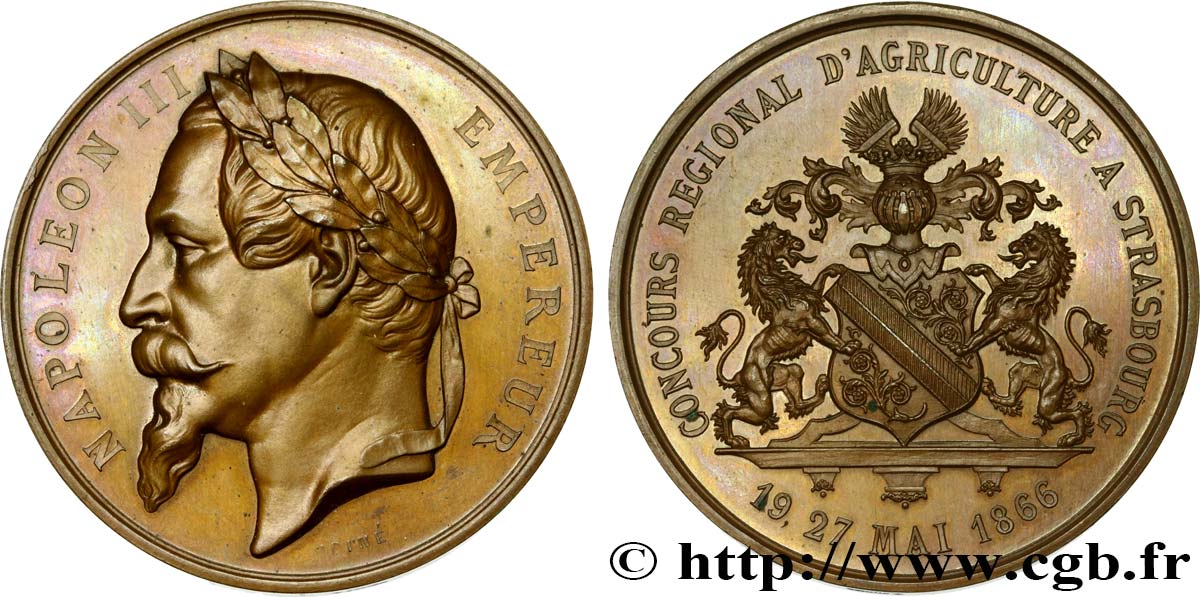
Bel exemplaire présentant quelques traces de manipulation dans les champs. Superbe blason de ville au revers. Faible usure
Лицевая сторона
Аверс: легенда: NAPOLÉON III - EMPEREUR.
Аверс: описание: Tête laurée de Napoléon III à gauche; signé : OUDINÉ.
Обратная сторона
Реверс: легенда: CONCOURS RÉGIONAL D’AGRICULTURE A STRASBOURG - 19, 27 MAI 1866.
Реверс: Описание: Blason de la ville de Strasbourg.
Комментарий
On remarquera la finesse des détails du blason de la ville de Strasbourg. Celui-ci est d’argent champ diapré à la bande de gueules. Il est le négatif des antiques armes de l'Evêché de Strasbourg.
Pour la petite histoire du blason, ses couleurs furent inversées par les bourgeois strasbourgeois suite à l'insurrection en 1262 contre la tutelle de l'évêque.
Un site internet parle de l’histoire de ce blason : http://svowebmaster.free.fr/drapeaux_Strasbourg.htm
Notons qu’il existe une variante en argent.
L’exemplaire est signé OUDINE sous le portrait. Eugène-André Oudiné, né à Paris le 1er janvier 1810, mort à Paris le 12 avril 1887, est un sculpteur, graveur et médailleur français. Il a été l'élève d’André Galle (1761 - 1844), de Louis Petitot (1794 - 1862) et de Jean-Auguste-Dominique Ingres (1780 - 1867). Il reçoit le premier grand prix de Rome de gravure en médailles en 1831. Il est l'auteur de plusieurs monnaies dont la pièce de 5 francs 1849 et 1850 en argent à la tête de Cérès de la Seconde République qui remplace l'écu au type Dupré de 1848. De 1837 à 1887 il fut le graveur officiel du Ministère des Finances. Il a également dessiné et gravé les timbres-télégraphe ainsi que les timbres pour journaux émis en 1868. Ses créations concernent également les timbres fiscaux : " Aigle de face " des timbres de dimension, " Aigle de trois-quart " des articles d'argent et des récépissés de chemins de fer, type " Chiffres " des timbres d'affiches, de connaissements, de copies, de quittances et type " Groupe allégorique " qui va servir pour les timbres fiscaux d'effets de commerce entre 1874 et 1885.
We will note the fine details of the coat of arms of the city of Strasbourg. This one is silver, field diapre with a band of gules. It is the negative of the ancient arms of the Bishopric of Strasbourg.
For the little history of the coat of arms, its colors were reversed by the bourgeois of Strasbourg following the insurrection in 1262 against the guardianship of the bishop.
A website talks about the history of this coat of arms: http://svowebmaster. free. fr/flags_Strasbourg. htm Note that there is a silver variant.
The copy is signed OUDINE under the portrait. Eugène-André Oudiné, born in Paris on January 1, 1810, died in Paris on April 12, 1887, was a French sculptor, engraver and medalist.. He was a student of André Galle (1761 - 1844), Louis Petitot (1794 - 1862) and Jean-Auguste-Dominique Ingres (1780 - 1867). He received the first Grand Prix de Rome for medal engraving in 1831.. He is the author of several coins including the 5 franc silver coin of 1849 and 1850 with the head of Ceres from the Second Republic which replaced the Dupré type shield of 1848. From 1837 to 1887 he was the official engraver of the Ministry of Finance.. He also designed and engraved the telegraph stamps and newspaper stamps issued in 1868. His creations also concern revenue stamps: \\\"Face Eagle\\\" for dimension stamps, \\\"Three-quarter Eagle\\\" for silver items and railway receipts, \\\"Figures\\\" type for poster stamps, bills of lading, copies, receipts and \\\"Allegorical Group\\\" type which will be used for revenue stamps for commercial papers between 1874 and 1885.
Pour la petite histoire du blason, ses couleurs furent inversées par les bourgeois strasbourgeois suite à l'insurrection en 1262 contre la tutelle de l'évêque.
Un site internet parle de l’histoire de ce blason : http://svowebmaster.free.fr/drapeaux_Strasbourg.htm
Notons qu’il existe une variante en argent.
L’exemplaire est signé OUDINE sous le portrait. Eugène-André Oudiné, né à Paris le 1er janvier 1810, mort à Paris le 12 avril 1887, est un sculpteur, graveur et médailleur français. Il a été l'élève d’André Galle (1761 - 1844), de Louis Petitot (1794 - 1862) et de Jean-Auguste-Dominique Ingres (1780 - 1867). Il reçoit le premier grand prix de Rome de gravure en médailles en 1831. Il est l'auteur de plusieurs monnaies dont la pièce de 5 francs 1849 et 1850 en argent à la tête de Cérès de la Seconde République qui remplace l'écu au type Dupré de 1848. De 1837 à 1887 il fut le graveur officiel du Ministère des Finances. Il a également dessiné et gravé les timbres-télégraphe ainsi que les timbres pour journaux émis en 1868. Ses créations concernent également les timbres fiscaux : " Aigle de face " des timbres de dimension, " Aigle de trois-quart " des articles d'argent et des récépissés de chemins de fer, type " Chiffres " des timbres d'affiches, de connaissements, de copies, de quittances et type " Groupe allégorique " qui va servir pour les timbres fiscaux d'effets de commerce entre 1874 et 1885.
We will note the fine details of the coat of arms of the city of Strasbourg. This one is silver, field diapre with a band of gules. It is the negative of the ancient arms of the Bishopric of Strasbourg.
For the little history of the coat of arms, its colors were reversed by the bourgeois of Strasbourg following the insurrection in 1262 against the guardianship of the bishop.
A website talks about the history of this coat of arms: http://svowebmaster. free. fr/flags_Strasbourg. htm Note that there is a silver variant.
The copy is signed OUDINE under the portrait. Eugène-André Oudiné, born in Paris on January 1, 1810, died in Paris on April 12, 1887, was a French sculptor, engraver and medalist.. He was a student of André Galle (1761 - 1844), Louis Petitot (1794 - 1862) and Jean-Auguste-Dominique Ingres (1780 - 1867). He received the first Grand Prix de Rome for medal engraving in 1831.. He is the author of several coins including the 5 franc silver coin of 1849 and 1850 with the head of Ceres from the Second Republic which replaced the Dupré type shield of 1848. From 1837 to 1887 he was the official engraver of the Ministry of Finance.. He also designed and engraved the telegraph stamps and newspaper stamps issued in 1868. His creations also concern revenue stamps: \\\"Face Eagle\\\" for dimension stamps, \\\"Three-quarter Eagle\\\" for silver items and railway receipts, \\\"Figures\\\" type for poster stamps, bills of lading, copies, receipts and \\\"Allegorical Group\\\" type which will be used for revenue stamps for commercial papers between 1874 and 1885.
Историческая справка
SECOND EMPIRE
(02/12/1852-04/09/1870)
Proclaimed Emperor under the name of Napoleon III, Louis Napoleon made his solemn entry into Paris on December 2, 1852.. He married Eugénie Marie de Montijo, a Spanish aristocrat, in January 1853. His reign can be divided into three periods: the authoritarian Empire until 1860; the Liberal Empire from 1860 to 1870 then the Parliamentary Empire in 1870. During the authoritarian Empire, Napoleon III exercised his power without sharing, controlled the press while the newspapers practiced self-censorship to avoid their suppression.. The prefects exercise unlimited power in the departments, the mayors, the civil servants are appointed by the government. As under the First Empire, Education and the University are monitored. Maintaining the main principles of the revolution, the sovereignty of the people is continued thanks to the consultation by plebiscite. On the economic level, the boom is important, industrialization develops as well as credit organizations and department stores. Military prestige is increased by the Crimean War which allows France to play an international role. The attack of Orsini (January 1858) does not prevent France from intervening in Italy to make triumph the principle of nationalities and allows the attachment of Nice and Savoy by the treaty of Turin (March 1860). From 1860, the Empire moved towards more freedoms: free trade treaty with England, appearance of a weak opposition in the Legislative Body, granting of the right to strike (1864), liberalization of the press (1868). On the international level, France acquires New Caledonia, Cochinchina and encourages the digging of the Suez Canal by Ferdinand de Lesseps. In Mexico, however, support for Maximilian and Austria was a failure. The 1869 elections were very bad for the regime and the opposition obtained 45% of the votes. The regime then evolved towards a parliamentary Empire by calling Émile Ollivier, leader of the Orléanist and liberal party, to power. After Sadowa in 1866 when Prussia crushed Austria, the affair of the throne of Spain and the dispatch from Ems led to the war which was declared on July 19, 1870. Accumulating setbacks, the French army was surrounded in Metz then Napoleon III, ill, capitulated at Sedan on September 2. As soon as the news was known, the decline of the Empire was announced by Gambetta, then the Republic was proclaimed on September 4.. Napoleon III was then taken captive to Hesse and then left for Kent where he died in 1873..
 Cообщить об ошибке
 Распечатать страницу
 Отправить мой выбор
 Задать вопрос
 Consign / sell
ПОХОЖИЕ ТОВАРЫ
 Информация



Your Recently Viewed Items

5 Dong VIET NAM 1946 P.004 VG
10.00 €

500 Dong VIET NAM 1951 P.064 UNC-
62.00 €

5000 Dong Lot VIET NAM 1987 P.104a UNC-
10.00 €
10 Euro EUROPA 2002 €.110.05 UNC
17.00 €
1000 Gulden SURINAM 1995 P.141b UNC
7.00 €
MACEDONIA - AMPHIPOLIS Tétradrachme stéphanophore XF
380.00 €
cgbfr.com для нумизматов


