


недоступный.
Товар уже продан в нашем интернет-магазине (2016)
Цена: : 695.00 €
Товар уже продан в нашем интернет-магазине (2016)
Цена: : 695.00 €
Тип Denier
Дата: 72
Монетный двор / Город: Antioche
Металл: silver
Проба: 900 ‰
Диаметр: 18,5 mm
Ориентация осей монеты: 6 h.
Вес: 2,95 g.
Редкость: R2
Комментарии о состоянии
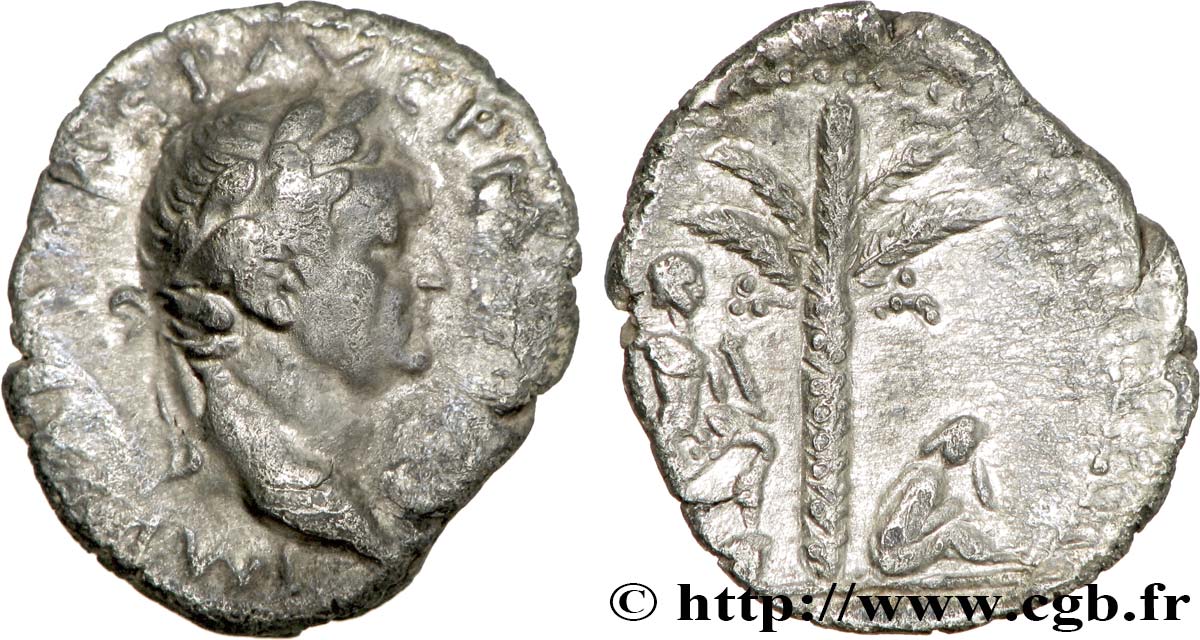
Exemplaire sur un flan ovale et irrégulier, mais néanmoins complet des deux côtés. Usure importante, mais parfaitement lisible et identifiable. Beau portrait. Faiblesse de frappe sur la légende au droit. Revers bien venu à la frappe. Recouvert d’une patine grise de collection ancienne légèrement granuleuse
Ссылки в каталоге: :
RCV.2278 (1760$) - RIC.363 - BMC/RE.510 - RSC.645 - C.645 (6f.) - MRK.- - BN/R.318 - RPC.1930 - GBC.763 (1750$)
Лицевая сторона
Аверс: легенда: IMP CAES VESP AV-G P M [COS IIII].
Аверс: описание: Tête laurée de Vespasien à droite (O*).
Аверс: перевод: “Imperator Cæsar Vespasianus Augustus Pontifex Maximus Consul quartum”, (L'empereur césar Vespasien auguste grand pontife consul pour la quatrième fois).
Обратная сторона
Реверс: легенда: ANÉPIGRAPHE.
Реверс: Описание: Vespasien, vêtu militairement debout à droite, le pied gauche posé sur un casque, tenant une javeline de la main droite et le parazonium de la main gauche placé sur le genou; la Judée voilée assise à droite, triste devant un palmier.
Комментарий
Poids léger. Au droit, le portrait est peu réaliste et ne ressemble pas encore aux portraits plus massifs de l’empereur, plus tardifs. L’attribution est donnée à l’atelier d’Antioche. La Judée est toujours assise à droite, voilée, le bras droit posé sur son genou et le bras gauche soutient le menton de la Province qui, suivant les exemplaires, est plus ou moins penchée vers l’avant dans une attitude de tristesse. Ce denier rappelle le sesterce de Vespasien (RCV. 2327) qui constitue la représentation la plus connue de la Judée vaincue. Au total, les auteurs du RPC ont recensé dix-huit exemplaires pour ce type avec onze coins de droit. C’est le type de denier avec la Judée captive le plus rare.
Light weight. On the obverse, the portrait is unrealistic and does not yet resemble the more massive portraits of the emperor, later. The attribution is given to the workshop of Antioch. Judea is always seated on the right, veiled, the right arm resting on her knee and the left arm supporting the chin of the Province who, depending on the copy, is more or less leaning forward in an attitude of sadness. This denarius recalls the sestertius of Vespasian (RCV. 2327) which constitutes the best-known representation of defeated Judea. In total, the authors of the RPC have identified eighteen examples for this type with eleven obverse dies. This is the rarest type of denarius with captive Judea
Light weight. On the obverse, the portrait is unrealistic and does not yet resemble the more massive portraits of the emperor, later. The attribution is given to the workshop of Antioch. Judea is always seated on the right, veiled, the right arm resting on her knee and the left arm supporting the chin of the Province who, depending on the copy, is more or less leaning forward in an attitude of sadness. This denarius recalls the sestertius of Vespasian (RCV. 2327) which constitutes the best-known representation of defeated Judea. In total, the authors of the RPC have identified eighteen examples for this type with eleven obverse dies. This is the rarest type of denarius with captive Judea
Историческая справка
VESPASIAN
(1/07/69-24/06/79)
Vespasien was born on November 17, 9 in Flacrines, near Reate (in Sabine country). He belongs to the Italian municipal bourgeoisie. Aedile in 38, lender in 40, consul in 51, proconsul of Africa in 63, he commanded with Claude the expedition to Brittany. Nero entrusted him with three legions and a proconsular imperium to crush the revolt of Judea in 66. He was proclaimed august on July 1, 69 in Alexandria and his sons, Titus and Domitian, were promoted to Caesar. Vitellius was eliminated on December 20, 69. Titus was directly associated with the government by his father from 71. His reign was devoted to the political and economic restoration of Rome. In 73, he took on the censorship. He died in Reate on June 24, 79.
 Cообщить об ошибке
 Распечатать страницу
 Отправить мой выбор
 Задать вопрос
 Consign / sell
ПОХОЖИЕ ТОВАРЫ

 Информация

Your Recently Viewed Items
PONTUS - AMISOS Tetrachalque VF
50.00 €
CAECILIA Denier XF
225.00 €
POSTUMUS Antoninien XF
16.00 €
MAXIMIANUS HERCULIUS Aurelianus AU
129.00 €
ROMAN REPUBLIC - ANONYMOUS Semis VF
125.00 €
LUCILIA Denier AU
150.00 €
cgbfr.com для нумизматов


