


Назад 1/1
E-auction 138-78141 - bpv_315199 - TRAJAN DECIUS Tétradrachme syro-phénicien
Чтобы принять участие в торгах, вы должны войти в систему и стать подтвержденным участником аукциона. Войдите, чтобы сделать ставку. Ваш аккаунт будет подтвержден в течение 48 часов. Не ждите до закрытия торгов, чтобы зарегистрироваться.Сделав ставку на данный товар, вы вступаете в юридическое соглашение на покупку выбранного товара и нажатием кнопки «Сделать ставку» подтверждаете принятие вами условий интернет-аукционов cgb.fr.
Ставка может бить сделана только в полном эквиваленте евро. Торги закроются согласно времени, указанному в описании товара, все ставки, сделанные после закрытия торгов, учитываться не будут. Не следует откладывать предложение вашей ставки до последнего момента, так как система может не успеть обработать вашу заявку, и ваша ставка не будет принята. Более детальную информацию вы найдёте здесь: FAQ по интернет-аукционам.
БЕСПЛАТНО.
БЕСПЛАТНО.
| Оценить : | 190 € |
| Цена : | 39 € |
| Максимальная предлагаемая цена : | 61 € |
| Конец торгов : | 07 December 2015 15:11:00 |
| Участников : | 9 Участников |
Тип Tétradrachme syro-phénicien
Дата: 251
Монетный двор / Город: Antioche, Syrie, Séleucie et Piérie
Металл: billon
Диаметр: 26 mm
Ориентация осей монеты: 10 h.
Вес: 12,03 g.
Редкость: R3
Комментарии о состоянии
Faible usure mais gros problèmes de surface
Ссылки в каталоге: :
Происхождение:
Cet exemplaire est le 0562_004 de la base TSP
Лицевая сторона
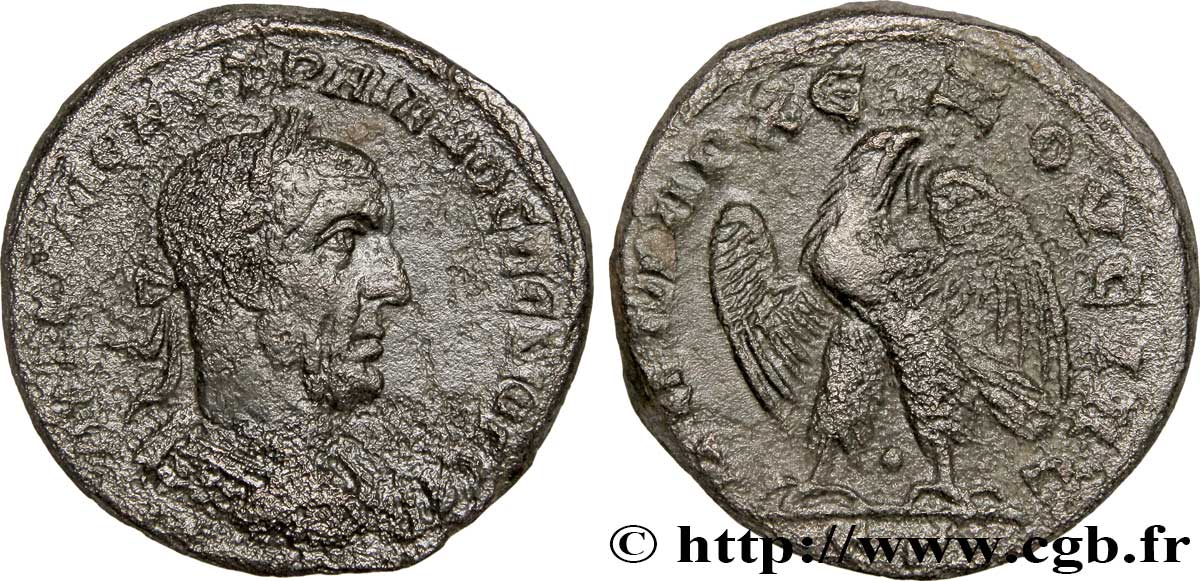
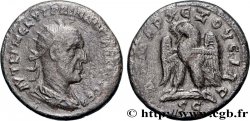
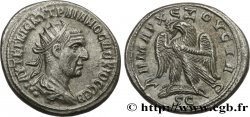
Аверс: описание: Buste lauré et cuirassé de Trajan Dèce à droite vu de trois quarts en arrière, IV sous le buste.
Аверс: легенда: AUT K G ME KU TRAIANOS DEKIOS SEB
Аверс: перевод: (L’empereur césar Caius Messius Quintus Trajan Dèce auguste).
Обратная сторона
Реверс: легенда: S C À L’EXERGUE.
Реверс: Описание: Aigle debout à gauche sur une ligne de terre, les ailes déployées, tête et queue à droite, tenant une couronne feuillée dans son bec, un globule entre les pattes.
Реверс: легенда: DHMARC EX OUSIAS
Реверс: перевод: (Revêtu de la puissance tribunitienne / avec l’accord du Sénat d’Antioche).
Комментарий
Bien entendu, cette émission est totalement énigmatique et questionne même l’interprétation des globules sous les bustes comme marques d’officines.
Pourquoi passer à une numérotation en chiffres romains alors qu’un type identique et au même revers va avoir une S, donc un 6 grec ?
Concernant le revers, la position de l’aigle est complètement nouvelle, la palme disparaît, pourquoi un seul point au lieu de quatre, qui seraient plus logiques ?
Une seule certitude, il ne s’agit pas d’une lubie puisque l’on trouve le même revers pour Herennia (Prieur 623), pour Herennius (Prieur 643) et pour Hostilien, toujours avec le IV, Prieur 653.
Le gros des émissions de Trajan Dèce porte une titulature avec son nom (Dèce) et son surnom adopté (Trajan). Ces émissions se répartissent sur deux années que l’on distingue par l’ordre nom/surnom dans la titulature. Nous connaissons l’ordre par comparaison avec les émissions d’Alexandrie où la même inversion se produit dans la titulature mais où les frappes sont datées (1ere ou 2e année).
Comme pour les émissions inaugurales, l’exergue ANTIOXIA des 3e et 4e consulats de Philippe disparaît et est remplacée par la palme, en usage avant le troisième consulat de Philippe. Faut-il en déduire que le financement des émissions changea et retourna aux autorités provinciales alors qu’elles auraient été assumées par la ville durant les 3e et 4e consulats de Philippe ? Il faut se rappeler que le frère de Philippe, Priscus, installé à Antioche pendant tout le règne avec tous les pouvoirs (y compris le titre de Rector Orientis !) avait peut-être obligé la ville à financer les émissions monétaires ; la source de son pouvoir disparue (on ignore sa fin) on peut imaginer que la ville se débarrassa du fardeau qui revint donc aux nouvelles autorités provinciales, trop heureuses de manifester leur allégeance au nouveau pouvoir par des émissions monétaires à son effigie.
Le choix adopté dans le Prieur, mettre tous les bustes particuliers à part, quelque soit leur officine, rend la lecture des émissions difficile et ne serait plus adopté aujourd’hui, au profit d’un classement par officines.
En effet, si le buste type, lauré, drapé et cuirassé prédomine très largement, on ne peut percevoir la logique de gravure des bustes exceptionnels qu’en fonction de leur présence où non dans des officines. Ce reclassement devra être fait.
On note que les sigma sont gravés en C.
Dans la base TSP maintenue par Michel Prieur, cinq exemplaires sont maintenant répertoriés pour ce type, dont trois en musées, deux à Yale/Doura et un à Paris.
Of course, this show is totally enigmatic and even questions the interpretation of the globules under the busts as pharmacy marks..
Why switch to Roman numerals when an identical type and the same reverse will have an S, therefore a Greek 6? Concerning the reverse, the position of the eagle is completely new, the palm disappears, why a single point instead of four, which would be more logical? One thing is certain: this is not a whim since we find the same reverse for Herennia (Prior 623), for Herennius (Prior 643) and for Hostilian, always with the IV, Prior 653.
The bulk of Trajan Decius's issues bear a title with his name (Deceius) and his adopted nickname (Trajan). These issues are spread over two years, distinguished by the name/nickname order in the title.. We know the order by comparison with the Alexandria issues where the same inversion occurs in the title but where the strikes are dated (1st or 2nd year).
As with the inaugural issues, the exergue ANTIOXIA of the 3rd and 4th consulates of Philip disappears and is replaced by the palm, in use before the third consulate of Philip. Should we deduce from this that the financing of the issues changed and returned to the provincial authorities when they would have been assumed by the city during the 3rd and 4th consulates of Philip? It must be remembered that Philip's brother, Priscus, installed in Antioch throughout the reign with all the powers (including the title of Rector Orientis!) had perhaps forced the city to finance the monetary issues; the source of his power having disappeared (we do not know how it ended) we can imagine that the city got rid of the burden which therefore fell to the new provincial authorities, only too happy to show their allegiance to the new power by issuing monetary issues bearing his image.
The choice adopted in the Priory, to put all the particular busts apart, whatever their office, makes the reading of the emissions difficult and would no longer be adopted today, in favor of a classification by offices.
Indeed, if the typical bust, laureate, draped and armored predominates very largely, we can only perceive the logic of engraving exceptional busts according to their presence or not in workshops. This reclassification will have to be done.
Note that the sigmas are engraved in C.
In the TSP database maintained by Michel Prieur, five examples are now listed for this type, including three in museums, two at Yale/Doura and one in Paris
Pourquoi passer à une numérotation en chiffres romains alors qu’un type identique et au même revers va avoir une S, donc un 6 grec ?
Concernant le revers, la position de l’aigle est complètement nouvelle, la palme disparaît, pourquoi un seul point au lieu de quatre, qui seraient plus logiques ?
Une seule certitude, il ne s’agit pas d’une lubie puisque l’on trouve le même revers pour Herennia (Prieur 623), pour Herennius (Prieur 643) et pour Hostilien, toujours avec le IV, Prieur 653.
Le gros des émissions de Trajan Dèce porte une titulature avec son nom (Dèce) et son surnom adopté (Trajan). Ces émissions se répartissent sur deux années que l’on distingue par l’ordre nom/surnom dans la titulature. Nous connaissons l’ordre par comparaison avec les émissions d’Alexandrie où la même inversion se produit dans la titulature mais où les frappes sont datées (1ere ou 2e année).
Comme pour les émissions inaugurales, l’exergue ANTIOXIA des 3e et 4e consulats de Philippe disparaît et est remplacée par la palme, en usage avant le troisième consulat de Philippe. Faut-il en déduire que le financement des émissions changea et retourna aux autorités provinciales alors qu’elles auraient été assumées par la ville durant les 3e et 4e consulats de Philippe ? Il faut se rappeler que le frère de Philippe, Priscus, installé à Antioche pendant tout le règne avec tous les pouvoirs (y compris le titre de Rector Orientis !) avait peut-être obligé la ville à financer les émissions monétaires ; la source de son pouvoir disparue (on ignore sa fin) on peut imaginer que la ville se débarrassa du fardeau qui revint donc aux nouvelles autorités provinciales, trop heureuses de manifester leur allégeance au nouveau pouvoir par des émissions monétaires à son effigie.
Le choix adopté dans le Prieur, mettre tous les bustes particuliers à part, quelque soit leur officine, rend la lecture des émissions difficile et ne serait plus adopté aujourd’hui, au profit d’un classement par officines.
En effet, si le buste type, lauré, drapé et cuirassé prédomine très largement, on ne peut percevoir la logique de gravure des bustes exceptionnels qu’en fonction de leur présence où non dans des officines. Ce reclassement devra être fait.
On note que les sigma sont gravés en C.
Dans la base TSP maintenue par Michel Prieur, cinq exemplaires sont maintenant répertoriés pour ce type, dont trois en musées, deux à Yale/Doura et un à Paris.
Of course, this show is totally enigmatic and even questions the interpretation of the globules under the busts as pharmacy marks..
Why switch to Roman numerals when an identical type and the same reverse will have an S, therefore a Greek 6? Concerning the reverse, the position of the eagle is completely new, the palm disappears, why a single point instead of four, which would be more logical? One thing is certain: this is not a whim since we find the same reverse for Herennia (Prior 623), for Herennius (Prior 643) and for Hostilian, always with the IV, Prior 653.
The bulk of Trajan Decius's issues bear a title with his name (Deceius) and his adopted nickname (Trajan). These issues are spread over two years, distinguished by the name/nickname order in the title.. We know the order by comparison with the Alexandria issues where the same inversion occurs in the title but where the strikes are dated (1st or 2nd year).
As with the inaugural issues, the exergue ANTIOXIA of the 3rd and 4th consulates of Philip disappears and is replaced by the palm, in use before the third consulate of Philip. Should we deduce from this that the financing of the issues changed and returned to the provincial authorities when they would have been assumed by the city during the 3rd and 4th consulates of Philip? It must be remembered that Philip's brother, Priscus, installed in Antioch throughout the reign with all the powers (including the title of Rector Orientis!) had perhaps forced the city to finance the monetary issues; the source of his power having disappeared (we do not know how it ended) we can imagine that the city got rid of the burden which therefore fell to the new provincial authorities, only too happy to show their allegiance to the new power by issuing monetary issues bearing his image.
The choice adopted in the Priory, to put all the particular busts apart, whatever their office, makes the reading of the emissions difficult and would no longer be adopted today, in favor of a classification by offices.
Indeed, if the typical bust, laureate, draped and armored predominates very largely, we can only perceive the logic of engraving exceptional busts according to their presence or not in workshops. This reclassification will have to be done.
Note that the sigmas are engraved in C.
In the TSP database maintained by Michel Prieur, five examples are now listed for this type, including three in museums, two at Yale/Doura and one in Paris
Историческая справка
TRAJAN DECIUS
(07/249-06/251)
Decius was born in 201 in Lower Pannonia. After a brilliant career which opened the doors of the Senate to him, he was governor of Lower Moesia under the reign of Alexander Severus. At the end of the reign of Philip, winner on the Danube of barbarian hordes, he was proclaimed august despite his refusal. He writes it to Philippe who does not believe him and marches against him. Philip and his son are killed in battle near Verona. Decius joins to his name that, prestigious, of Trajan. After a stint in Rome, Decius travels to the Danubian Limes. Deserted, the limes allowed the Goths to filter through, ravaging the Danubian provinces, where the Emperor originated. He fails to stem the invasion. From 250, a new plague ravages the Empire. The plague decimated population and herds and further weakened the limes. He began a persecution against Christians in 250 (Polyeucte, Corneille). The following year, he went to the limes, defeated the Goths, but his son was killed. He himself finds death while wanting to avenge him. He is the first emperor to fall in battle against the Barbarians.
 Cообщить об ошибке
 Распечатать страницу
 Отправить мой выбор
 Задать вопрос
 Consign / sell
ПОХОЖИЕ ТОВАРЫ
 Информация

Your Recently Viewed Items
MAXIMIANUS HERCULIUS Follis ou nummus AU
130.00 €

GUADELOUPE Bon pour 1 Franc 1921 XF
6.00 €

5 centimes Cérès 1886 Paris F.118/28 XF45
27.00 €

2 francs Morlon, aluminium 1941 F.269/2 MS63 PCGS
60.00 €

ITALY - RÉPUBLIQUE ROMAINE 2 Baiocchi N.D. Rome AU
190.00 €

ITALY 500 Lire “caravelles” 1958 Rome AU
12.00 €
cgbfr.com для нумизматов


