


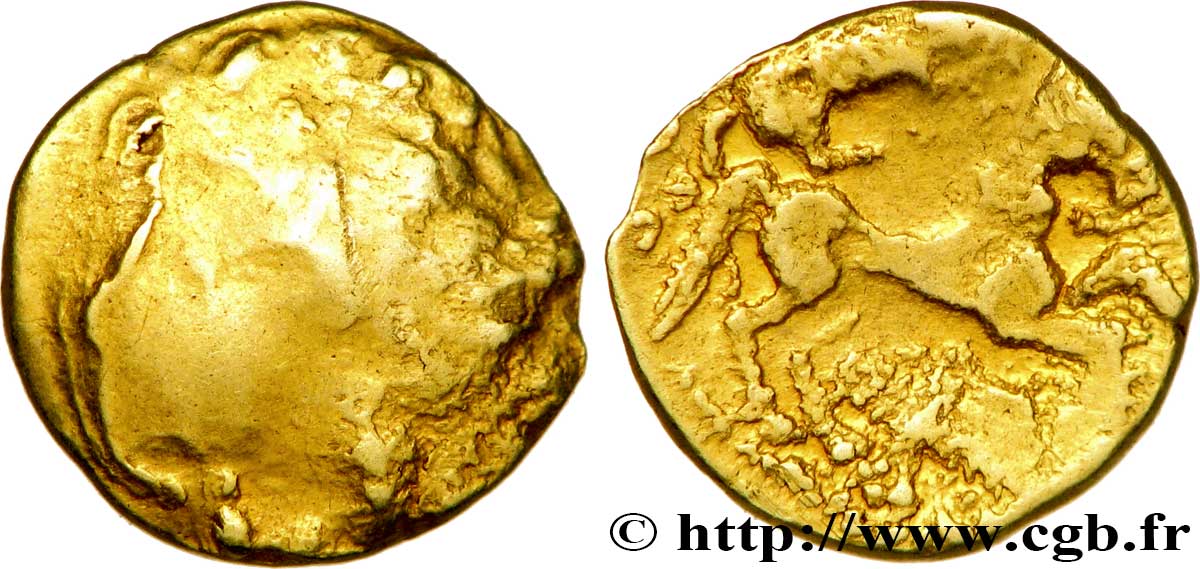
bga_241277 - GALLIA - CARNUTES (Area of the Beauce) Quart de statère d’or au sanglier conducteur
недоступный.
Товар уже продан в нашем интернет-магазине (2016)
Цена: : 590.00 €
Товар уже продан в нашем интернет-магазине (2016)
Цена: : 590.00 €
Тип Quart de statère d’or au sanglier conducteur
Дата: Ier siècle avant J.-C.
Монетный двор / Город: Chartres (28)
Металл: gold
Диаметр: 12,5 mm
Ориентация осей монеты: 3 h.
Вес: 1,96 g.
Редкость: R3
Комментарии о состоянии
Beau revers complet, mais avers très confus bien que centré. La tête se devine à peine, issue d’un coin très usé
Лицевая сторона
Аверс: легенда: ANÉPIGRAPHE.
Аверс: описание: Tête imitée de Philippe II, à droite ; la base du cou perlée.
Обратная сторона
Реверс: легенда: ANÉPIGRAPHE.
Реверс: Описание: Cheval harnaché à droite, sanglier-aurige sur la croupe ; petit aigle aux ailes éployées entre les jambes du cheval ; une ligne ondulée devant le cheval.
Комментарий
Dans le Nouvel Atlas, cette monnaie est reprise sous la série "au loup conducteur".
Cet exemplaire, par rapport aux deux monnaies précédentes, illustre la dégénérescence des types par l’usure des coins...
Le revers est encore bien net tandis que le droit devient très confus. Il semblerait que le coin de droit s’use plus vite ou bien que les coins de revers (mobiles) soient remplacés plus vite (inutilisables dès qu’ils sont cassés) alors que les coins de droit (fixes) peuvent continuer à être utilisés même cassés (?).
Si aucun statère n’est connu, un hémi-statère a été récemment publié, élargissant cette série jusque là orpheline.
In the New Atlas, this coin is included under the series \\\"with the driving wolf\\\". This example, compared to the two previous coins, illustrates the degeneration of the types by the wear of the dies... The reverse is still very clear while the obverse becomes very confused. It would seem that the obverse die wears out more quickly or that the reverse dies (mobile) are replaced more quickly (unusable as soon as they are broken) while the obverse dies (fixed) can continue to be used even if broken (?). If no stater is known, a hemi-stater was recently published, expanding this series which was previously orphaned
Cet exemplaire, par rapport aux deux monnaies précédentes, illustre la dégénérescence des types par l’usure des coins...
Le revers est encore bien net tandis que le droit devient très confus. Il semblerait que le coin de droit s’use plus vite ou bien que les coins de revers (mobiles) soient remplacés plus vite (inutilisables dès qu’ils sont cassés) alors que les coins de droit (fixes) peuvent continuer à être utilisés même cassés (?).
Si aucun statère n’est connu, un hémi-statère a été récemment publié, élargissant cette série jusque là orpheline.
In the New Atlas, this coin is included under the series \\\"with the driving wolf\\\". This example, compared to the two previous coins, illustrates the degeneration of the types by the wear of the dies... The reverse is still very clear while the obverse becomes very confused. It would seem that the obverse die wears out more quickly or that the reverse dies (mobile) are replaced more quickly (unusable as soon as they are broken) while the obverse dies (fixed) can continue to be used even if broken (?). If no stater is known, a hemi-stater was recently published, expanding this series which was previously orphaned
Историческая справка
GALLIA - CARNUTES (Beauce area)
(2nd - 1st century BC)
The Carnutes were one of the most important and powerful peoples of independent Gaul. Their territory stretched between the Loire and the Seine over the Orléanais, the Blésois and the Chartrain country as far as Mantes, that is to say the greater part of the current departments of Loiret, Loir-et-Cher and Eure-et-Loir and part of Yvelines. Their economic center was located in Genabum (Orléans), but their main oppidum seems to have been Autricum (Chartres). They would have participated in the legendary Bellovèse expedition to Italy. They formed the geographical center of Gaul and, long before the start of the Gallic Wars, Roman merchants knew the way to Genabum (Orléans), then a major commercial center. The Carnutes were also famous for their forest where the annual meeting of the Druids was held.. At the start of the War, Caesar had wintered with the Carnutes in 57 BC.. -VS. and had imposed on them as king Tasgetios, who was assassinated in 54 BC. -VS. The following year, they submit but at the beginning of 52 BC. -VS. , they are perhaps at the origin of the revolt which will raise the whole of Gaul. It is possible that the conspirators met during a druidic assembly. The Carnutes massacred the Roman settlers and merchants of Genabum (Orleans) under the leadership of Cotuatos and Conconnétodumnos. Caesar came to besiege the city which he took, pillaged and burned, marking the beginning of hostilities. The Carnutes then provided a contingent of twelve thousand men to the relief army in order to clear Alesia. After the fall of Vercingetorix, the following year, the Romans carried out a new campaign of pacification and Caesar punished the assassins of the previous year. Caesar (BG. II. 35; V, 25, 29, 56; VI, 2-4, 13, 44; VII. 2, 3, 11, 75; VIII. 4, 5, 31, 38, 46). Strabo (G. IV, 2, 3); Livy (HR. V, 34). Ptolemy (G. II, 8). Kruta: 68, 187, 334.
 Cообщить об ошибке
 Распечатать страницу
 Отправить мой выбор
 Задать вопрос
 Consign / sell
ПОХОЖИЕ ТОВАРЫ
 Информация



Your Recently Viewed Items

Dix centimes Napoléon III, tête nue, satirique 1854 Strasbourg F.133/13 var. X
95.00 €
Dix centimes Napoléon III, tête laurée, satirique Napoléon III en Diable 186
190.00 €
Dix centimes Napoléon III, tête nue, satirique 1854 Strasbourg F.133/14 var. V
60.00 €

MOZAMBIQUE 1 Escudo colonie portugaise du Mozambique 1953 XF
5.00 €
GALLIA - CARNUTES (Regione della Beauce) Potin à l’aigle de face et à la tê
110.00 €

Monnaie satirique, dix centimes Napoléon III, tête nue, regravée 1852 Paris F
245.00 €
cgbfr.com для нумизматов


